
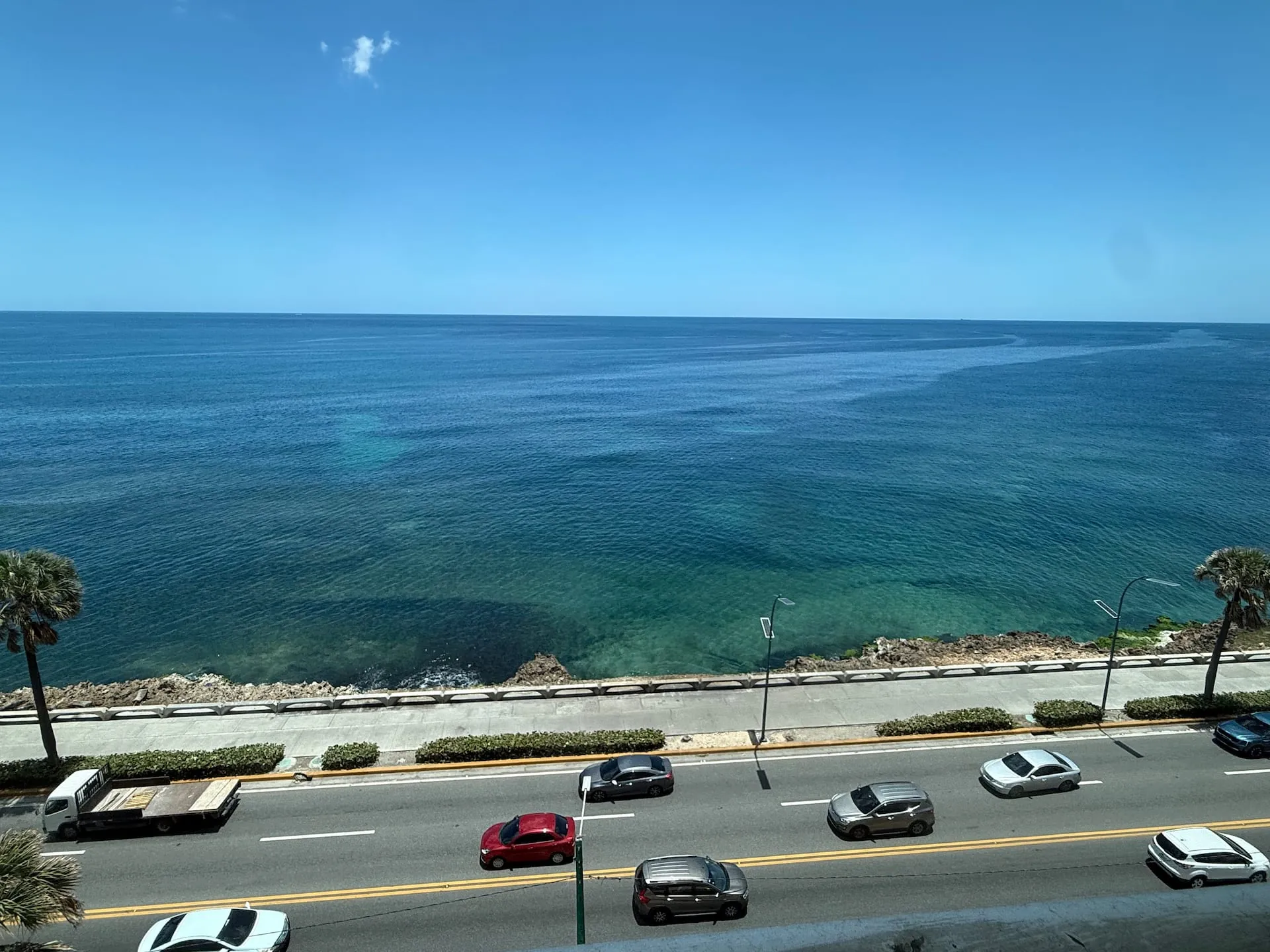
Santo Domingo is easy to get around once you know the options. From our apartments on the Malecón, the Colonial Zone is about 5 minutes by car, the promenade along the sea is right outside, and a ride-hailing car can take you almost anywhere in the city at any hour. For longer trips there is the Metro, the cable car, and the highways east to the beaches and west to Baní.
This guide covers each way of getting around: ride-hailing and taxis, the Metro and the Teleférico, buses, walking, driving and parking, and how to reach the beaches, the ballpark and the day trips from the Malecón.
From the airport
If you fly into Las Américas International Airport, east of the city, ride-hailing apps can pick you up there, and you can reserve an airport ride up to 30 days ahead. For the full picture, including the route along the coast, taxis, transfers and what to expect at arrivals, see our guide to getting from the airport to the Malecón.
The airport is also close to Boca Chica, the capital's main beach, so on your last day you can fit in a morning swim before your flight.
Ride-hailing and taxis
Ride-hailing is the easiest way to get around the city. Uber operates in Santo Domingo around the clock, and UberXL takes groups of up to six, which suits families and friends traveling together. You can also schedule a ride up to 30 days ahead, which helps for early flights and evening plans.
Tips for ride-hailing
Before you set off, save your apartment's address in the app and check that the pin sits on the Malecón where you want it. When you go out for the evening, agree with your driver where you will meet for the ride home, or book the return before the event ends; this matters most at the ballpark, concerts and parades, when crowds leave at once.
Taxis
If you prefer a taxi, use a licensed company or one your host arranges, and agree on the fare before you leave.
The Santo Domingo Metro
The Santo Domingo Metro is a quick, inexpensive way to cross the city. Line 1 opened in 2009, and Line 2 opened in two stages, in 2013 and 2018. Together with the Teleférico, the cable car, it forms one integrated system, with the same cards and fares on both.
The lines
- Line 1 runs from Mamá Tingó to Centro de los Héroes, and the full ride takes about 25 minutes.
- Line 2 runs from María Montez to Concepción Bona, and the full ride takes about 26 minutes.
- The two lines meet at Juan Pablo Duarte station, where you can change trains.
- The Teleférico Line 1 runs from Gualey to Charles de Gaulle in about 22 minutes.
The station nearest the Malecón
Centro de los Héroes, the southern end of Line 1, sits a few blocks inland from the western part of the Malecón. From there, Line 1 reaches Juan Pablo Duarte, the transfer station, in about 9 minutes, and from Juan Pablo Duarte, Line 2 runs on to Concepción Bona in about 15 minutes.
If your apartment is toward the Colonial Zone end of the Malecón, a short ride-hailing trip to the station is often quicker than the walk, especially in the midday heat.
The southern end of Line 1
Riding north from Centro de los Héroes, Line 1 stops at Francisco Alberto Caamaño Deñó, Amín Abel Hasbún, Joaquín Balaguer, Casandra Damirón and Profesor Juan Bosch before reaching Juan Pablo Duarte, where you can change to Line 2. Many stations are named after Dominican public figures, so the names on the platform signs are a short lesson in the country's history. Count your stops and watch the signs on the platform.
Fares and cards
A trip on the Metro or the Teleférico costs RD$20. You need a card to ride, and there are two kinds:
- The rechargeable plastic card costs RD$60 and is sold with at least two trips loaded, so your first purchase is RD$100. You can top it up with any amount from RD$20 to RD$7,000.
- The single-use card adds RD$15 to the fare, so one trip costs RD$35 and a round trip RD$55.
- A 24-hour pass gives unlimited rides for a day from the first use, for RD$80 plus the RD$15 card, RD$95 in all.
- Frequent riders can load a Multi10 pack of 10 trips for RD$185 or a Multi20 pack of 20 trips for RD$360 on a rechargeable card.
Ticket windows take cash only. For a short stay with a few rides, the 24-hour pass or a rechargeable card with a few trips loaded is the simplest choice.
You can also skip the card. The validators at the gates accept contactless debit and credit cards, so you can tap your own bank card to ride.
The integrated fare
Since July 2026, a trip that combines the Metro, the Teleférico, OMSA buses and the integrated bus corridors costs no more than RD$35 in total. Tap the same rechargeable Metro card on your first ride, and you have 90 minutes to make up to two transfers. A Metro-only trip still costs RD$20, and the combined fare does not apply to the Multi10 and Multi20 packs.
Hours
The Metro runs Monday to Friday from 6:00 a.m. to 10:30 p.m., and on weekends and public holidays from 6:00 a.m. to 10:00 p.m. Plan your last ride home with those times in mind.
Riding with bicycles
Bicycles are allowed on the Metro on Saturdays from 10:00 a.m. to 10:00 p.m., and all day on Sundays and public holidays.
Tips for riding the Metro
Buy your card at the ticket window, tap in at the turnstiles and keep the card until you leave the system. Rush hours are the busiest times, so plan sightseeing rides for the middle of the morning or early afternoon. Keep your bag in front of you in a crowded car, as you would in any big city.
Accessibility
The Metro is built for riders with reduced mobility. Stations have tactile guide paths for blind riders, elevators and ramps, and easy-access gates into the paid area. Platforms and trains have preferential areas with space to secure a wheelchair, and marked priority seats. Staff from CESMET, the system's security corps, are on hand to assist.
Lost items and questions
If you leave something behind, report it at any station ticket window, call the service center at 809-333-2670, extension 11112, or use the online form on the transit authority's website. Questions and suggestions go through the same channels, or into the suggestion box in each station.
A growing network
The system is still expanding. Five new stations are under construction on Line 2C, a 7.3 km extension toward Los Alcarrizos that will connect with the second Teleférico line. Line 1's above-ground stations have been lengthened for six-car trains, and a 2.5 km extension of Line 1 toward Punta de Villa Mella, with two new stations, is under way.
The Teleférico
The Teleférico de Santo Domingo is the city's cable car. It opened in May 2018, runs for about 5 km, and stops at four stations: Gualey, Tres Brazos, Sabana Perdida and Charles de Gaulle. Each cabin holds up to 10 people, and the full ride takes about 22 minutes.
The Teleférico uses the same cards and fares as the Metro. It runs Monday to Friday from 6:00 a.m. to 10:30 p.m., on Saturdays from 6:00 a.m. to 9:00 p.m., and on Sundays from 8:00 a.m. to 9:00 p.m.
The ride above the rooftops shows you the city from the air. Go on a clear morning, and treat the cable car as an outing in itself. The stations have elevators, ramps and tactile paths, and the cabins adapt for riders with reduced mobility.
A second line, in Los Alcarrizos on the city's western edge, opened in May 2023 and ran free for its first month. It stays in service, with short stops for scheduled maintenance, such as the one from July 10 to July 19, 2026.
Buses
The city's public bus company, OMSA, runs buses on the main corridors of Greater Santo Domingo. In 2026 it began rebuilding its fleet for an estimated 54 million trips in 2026 and 2027, starting with four priority trunk corridors and 46 recovered buses.
OMSA buses and the integrated corridors are part of the same fare system as the Metro: tap a rechargeable Metro card, or a contactless bank card, and a combined trip within 90 minutes costs no more than RD$35. Routes and stops take some learning, so most short-stay guests find ride-hailing simpler for the trips they make.
If you want to try a bus, ask your host which line passes closest to the Malecón and where it goes.
Walking
Walking the Malecón
The Malecón is made for walking. Head out early in the morning or around sunset, the coolest times of the day. Güibia, the city's old beach, is on the Malecón and makes a good turning point for a walk. Our Malecón guide covers the promenade end to end.
On the big parade days, parts of Avenida George Washington close to traffic. In 2026 the stretch between calle Pasteur and calle Palo Hincado closed from the Friday afternoon before the carnival parade, and drivers were sent along Avenida Independencia and Avenida Simón Bolívar. The avenue was also partly closed on February 27 for the Independence Day parade. On those days, walk to the parade and plan any car trips around the closures.
Walking the Colonial Zone
The Colonial City of Santo Domingo, founded in 1498, is a UNESCO World Heritage site, inscribed in 1990. It was the site of the first cathedral, hospital, customs house and university in the Americas, and its streets were laid out on a grid that town planners across the New World copied. That grid makes it an easy place to explore on foot.
Calle El Conde is the Colonial Zone's pedestrian street. It crosses the district from east to west for about 10 blocks, starting at the Dominican Republic's Kilómetro Cero and passing the Palacio Consistorial, the Edificio Copello and Parque Colón, with its west end facing the Altar de la Patria. Street artists sell paintings along the way.
From the Malecón, the Colonial Zone is about 5 minutes by car, so a short ride there and a day on foot works well. Wear comfortable shoes for the old streets, carry water, and plan indoor stops for the hottest part of the day. Our Colonial Zone guide covers the streets, sights and museums in detail.
Parade days on the Malecón
The Malecón is the city's parade route. Besides the Independence Day parade on February 27, it hosts the Distrito Nacional carnival in February and the Ministry of Culture's national carnival parade, held on Sunday, March 15, in 2026, with about 180 comparsas from every province. On those days, walk to the parade, and leave any car trips for before the closures or after the crowds have gone home.
Driving and renting a car
A car is useful for day trips and beach days, though you can manage without one in the city itself. If you rent, here is what to know.
Rules of the road
Traffic drives on the right, as in the United States. Seat belts are required for the driver and passengers, and drivers who are distracted by a phone or another device can be fined. Children up to six years old must ride in an infant or child seat, and children from six to twelve use a booster seat with the rear seat belt, so ask your rental company for the right seat when you book.
Tolls
The main highways out of the city have toll stations. The Las Américas toll, on the road east toward the airport and the beaches, has lanes for Paso Rápido, the electronic toll tag, and cash lanes. Ask your rental company whether the car has a tag, and keep pesos handy for the cash lanes if it does not. With a tag, the barrier reads it and lifts in a few seconds, which saves a real wait at busy times.
Parking at the apartments
Our Malecón apartments include parking on the premises, so you can keep a rental car at home between trips. Check the details for your apartment when you book.
Driving out of the city
The main routes from the Malecón are simple:
- East to Boca Chica, about 37 km, on the Autopista Las Américas past the airport turnoff
- Further east to Juan Dolio, about 59 km, on the same road
- East to Bayahíbe, about 135 km, on the Autopista Las Américas and the Autovía del Este
- West to Baní and Boca Canasta, about 61 km, on the Autopista 30 de Mayo, the Autopista 6 de Noviembre and the Autopista San Cristóbal-Baní
Leave after the morning rush and plan to be back before evening traffic, especially on Fridays and before holidays.
Getting to the beaches
Boca Chica is the nearest full beach to the Malecón, about 37 km east, and a ride-hailing car is the easiest way there. Juan Dolio, about 59 km away, is a longer ride on the same road. For Saona Island, book a tour that collects you from your apartment and handles the drive to Bayahíbe and the boat. Our beaches guide covers each beach and how to plan the day.
Getting to the ballpark
The Estadio Quisqueya Juan Marichal, home of the Licey and the Escogido, is about 6 km from the Malecón in Ensanche La Fe. Take a ride-hailing car or a taxi arranged by your host, leave early for evening games, especially on Fridays, and agree on a pickup point before the game ends. Weekday games usually start between 7:00 and 7:30 p.m., and weekend games in the late afternoon. For the new VIP zone, the entrance is the gate on Avenida San Cristóbal.
Getting to the day trips
The closest day trips are within the city. Los Tres Ojos is about 11 km from the Malecón, in Santo Domingo Este, and the Jardín Botánico Nacional is about 10 km away in the northwest of the city; both are an easy ride-hailing trip. For the longer trips, the Cueva de las Maravillas, Altos de Chavón, Bayahíbe and the Baní dunes, a rental car or a tour with hotel pickup makes the day simpler.
A day in the city without a car
You can see a great deal without ever renting a car. Here is one plan:
- Start with an early walk along the Malecón as the sun comes up over the sea.
- Take a ride-hailing car to the Colonial Zone, about 5 minutes away, and spend the morning on foot along Calle El Conde.
- Ride the Metro across the city in the early afternoon, buying a 24-hour pass at the ticket window.
- Go up on the Teleférico for the view, and ride back into town before evening.
- Finish with a sunset walk back on the Malecón.
Getting to Baní and Boca Canasta
Baní and Boca Canasta lie about 61 km west of the Malecón. The drive follows the coast west on the Autopista 30 de Mayo, then the Autopista 6 de Noviembre and the Autopista San Cristóbal-Baní, before the Circunvalación de Baní and Avenida Fabio Herrera bring you into Boca Canasta. From Las Américas International Airport the trip is about 91 km, since the airport is east of the capital.
Choosing how to get there
A quick guide to the easiest way for each kind of trip:
- To the Colonial Zone: a ride-hailing car, about 5 minutes, then walk
- Across the city: the Metro, with Line 1 and Line 2 meeting at Juan Pablo Duarte
- To the ballpark: a ride-hailing car, about 6 km, with a pickup point agreed for after the game
- To Boca Chica: a ride-hailing car or a rental car, about 37 km east
- To Saona Island: a tour with hotel pickup, back about 11 hours later
- To the Baní dunes: a rental car or a four-hour tour with hotel pickup
- To the botanical garden or Los Tres Ojos: a short ride-hailing trip, about 10 to 11 km
Paying for transport
Carry some pesos in small bills. Metro ticket windows take cash only, and toll booths on the highways have cash lanes alongside the Paso Rápido lanes. On the Metro and Teleférico you can also tap a contactless debit or credit card at the gates instead of buying a card.
Getting around at night
Ride-hailing runs around the clock, so it is the easy choice for dinners, concerts and late nights out. The Metro closes at 10:30 p.m. on weekdays and 10:00 p.m. on weekends and holidays, and the Teleférico at 9:00 p.m. on weekends, so plan the last leg home by car if you will be out late.
Getting around with children and older travelers
For families, UberXL fits up to six, and the law requires infant seats for children up to six and booster seats from six to twelve, so ask for the right seat when you rent a car or book a transfer. On the Metro, elevators, ramps, priority seats and wheelchair spaces make the trip easier for grandparents and strollers alike.
Spanish for getting around
A few words help:
- estación: station
- boletería: the ticket window
- tarjeta recargable: the rechargeable transit card
- viaje: a trip, as in a card loaded with two trips
- transbordo: a transfer between lines or services
- peaje: a highway toll, and Paso Rápido, the electronic toll tag
Getting around on holidays
On public holidays the Metro keeps its weekend hours, from 6:00 a.m. to 10:00 p.m., and the Teleférico runs on its own schedule, so check before you set out. Holy Week and the long weekends send families from the capital to the beaches, and from mid-December the airports fill with Dominicans coming home for Christmas, so travel early in the day and allow extra time.
Book your apartment on the Malecón and start every trip from the edge of the sea.