
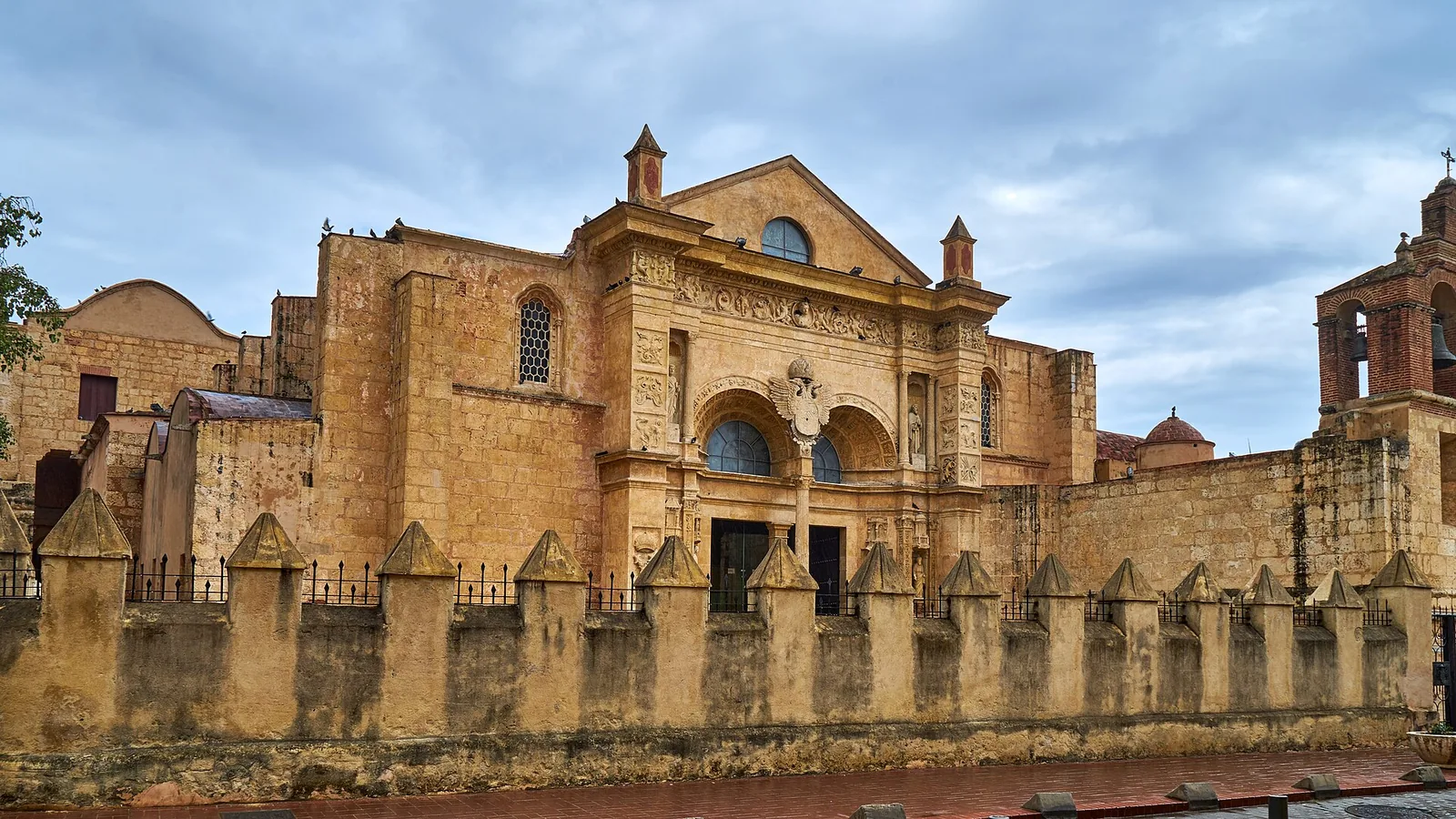

The Ciudad Colonial is the old walled town at the mouth of the Ozama River, the place where Santo Domingo began. UNESCO added it to the World Heritage List in 1990, and the protected area covers 106 hectares of streets, plazas, churches, museums and the old fortress.
From our apartments on the Malecón, the colonial area is 5 minutes away by car. That makes it easy to spend a morning among the old stone buildings, come back to the sea for a rest when the sun is high, and return in the evening for dinner on a plaza.
This guide walks through the streets, plazas, museums, churches and fortress, then sets out a plan for a morning and a plan for a full day, and ends with the opening days that catch visitors out. Restaurants have their own page in our Dominican food guide, and the Sunday night music in the ruins is covered in nightlife and music.
Why the old city matters
After Columbus reached the island in 1492, Santo Domingo became the site of the first cathedral, hospital, customs house and university in the Americas. The town was founded in 1498 and laid out on a grid that became the model for almost every town planner in the New World.
The first settlement went up on the east bank of the Ozama in 1496. Bartholomew Columbus founded the city in 1498, and in 1502 the governor, Nicolás de Ovando, moved its institutions to the west bank and laid out the streets in a checkerboard from the main square, the Plaza Mayor. That west-bank grid is the Colonial Zone you walk today.
The scale is made for walking: 32 streets crossing 116 blocks, bordered by walls, bastions and forts. Most buildings are one or two stories high, with walls of stone, brick or earth, and the original street plan and widths have survived almost intact.
The old city also has a place in the history of human rights. It was here that the Dominican friar Antonio Montesino made his appeal for the natural rights of the island's native people, an appeal remembered as the start of the fight for basic human rights in the Americas.
Getting there from the Malecón
A taxi from the Malecón to the colonial area takes 5 minutes. Ask to be let out at Parque Colón, the old Plaza Mayor, or at the Puerta del Conde, the stone gate that faces the start of Calle El Conde. Both are within easy walking distance of most of this guide.
You can also walk in along the sea. The Malecón runs east toward the old city, and the walk is most pleasant early in the morning or late in the afternoon, when the sun is lower and the breeze comes off the water. A good pattern is a taxi in for the morning and a walk back along the promenade before sunset.
Our getting around guide has the details on taxis and other ways to move around the city. Once you are inside the Colonial Zone, go on foot: the streets are narrow, the blocks are short, and the next plaza is never far.
Parque Colón and the Catedral Primada
Parque Colón was once the Plaza Mayor, the main square of the colonial city. A tall statue of Christopher Columbus stands in the middle, his arm pointing outward, with the Taíno heroine Anacaona at his feet looking up at him. There are benches under the trees and merengue players on the square, which is framed by the cathedral, the cathedral museum and the Palacio Borgella. Restaurants, cafés and bars sit around its edges, so this is the natural place to start and to come back to.
The Basilica Cathedral of Santa María la Menor, known as the Catedral Primada de América, is the first cathedral built in the Americas. Construction ran from 1514 to 1542. The walls are coral stone, the vaulted ceiling shows both Gothic and Renaissance work, and the side chapels hold colonial sculpture and paintings. Inside is the tomb of Admiral Diego Colón, son of Christopher Columbus.
Plan on an hour to an hour and a half inside. There are prayer areas, so dress respectfully and keep your voice down, and consider a guided tour, which points out details that are easy to walk past. The cathedral museum, on the same square, shows paintings, candlesticks, crucifixes and other objects from the cathedral's long history.
Calle Las Damas
Calle Las Damas is the first paved street in the Americas. The name means "street of the ladies," after María de Toledo, the wife of Diego Colón, and the women of her household, who stepped out of the palace in the evenings to stroll up and down it. Sixteenth-century houses line both sides, and many are now museums, embassies and hotels.
The Panteón de la Patria, the national pantheon, is on this street. It was built as a Jesuit church in the 18th century and became the national mausoleum in 1956. A presidential honor guard protects it every day. Inside lie Dominican heroes such as Gregorio Luperón, the poet Salomé Ureña and María Trinidad Sánchez, under a ceiling mural of the Last Judgment with an eternal flame burning beneath it.
Walk on and you pass the House of Hernán Cortés, which is now the French embassy, and the Hotel Nicolás de Ovando, named for the governor who laid out the streets.
Plaza María de Toledo, a small square with a fountain and benches, links Calle Las Damas with Calle Isabel la Católica. Couples come here for a quiet moment away from the busier blocks, and it is a good place to sit between museums.
For something sweet, the Kahkow Experience is a cacao and chocolate center on Calle Las Damas, where the story of cacao in the Dominican Republic is told.
The Fortaleza Ozama
The Fortaleza Ozama was built from 1502 to 1508 under Governor Nicolás de Ovando, and it is the first permanent military structure in the Americas. It sits at the back of a large walled yard by the river, built of coral stone in the shape of a medieval castle.
The central tower, the Torre del Homenaje, rises 69 feet. A spiral staircase leads to a lookout platform with views over the Ozama River and the port, and the original cannons still face the river they were placed to defend. Below are tunnels and old cells to explore.
In 2026 the fortress was showing new interactive exhibition spaces, and in summer it has stayed open into the evening as part of the Noches Largas de Museos, with hours until 9 p.m.
Plaza de España and the Alcázar de Colón
The Plaza de España sits at the end of Calle Las Damas, a wide open esplanade with the Alcázar de Colón on one side and a row of outdoor restaurant terraces on the other. A statue of Nicolás de Ovando stands in the center. Concerts, cultural shows and festivals are held here, and at sunset it is one of the most romantic spots in the old city for dinner or an evening stroll.
The Alcázar de Colón was built between 1511 and 1514 as the residence of the viceroy Diego Colón, eldest son of Christopher Columbus. In the early years of Spanish rule it was the seat of government and the center of colonial administration in the New World. Today it is a museum of the period, open Tuesday to Saturday from 9 a.m. to 5 p.m. and Sunday from 9 a.m. to 4 p.m.
Next to the plaza, on Calle La Atarazana, the Museo de las Atarazanas Reales tells the island's maritime story in the old royal warehouses, which once served as a shipyard and storehouse for building and repairing ships and for controlling sea trade. It opens Tuesday to Sunday from 10 a.m. to 6 p.m.
Pat'e Palo, on the Plaza de España, gives 1505 as its founding year and calls itself the first tavern of the New World. Today it is a European-style brasserie with terrace tables facing the Alcázar.
The Museo de las Casas Reales
The Museo de las Casas Reales, the Museum of the Royal Houses, occupies the building that held the Spanish Royal Court in the 16th century, along with the governor's palace and the treasury. Its rooms walk you through Dominican history from 1492 through the colonial era and slavery to the first independence from Spain in 1821.
Expect displays on the voyages of Columbus with ship replicas, a collection of period treasures, and weapons from the era of the dictator Rafael Leónidas Trujillo, all arranged around wide Spanish courtyards. It pairs well with the Alcázar in a single morning.
Calle El Conde
Calle El Conde was the first commercial street in the New World, and it is still the most popular pedestrian shopping street in the country. It runs for more than 10 blocks, from Parque Independencia past Parque Colón to Calle Las Damas, lined with restaurants, cafés, souvenir shops and grocery stores.
Street artists set out their paintings along the way, and vendors push ice cream carts up and down the stone paving. It is the easiest street in the Colonial Zone to find your way along, because it cuts straight across the old city.
On the Parque Colón end, Jalao at Calle El Conde 103 serves Dominican food with live merengue, bachata and perico ripiao, and it stays open late on weekends. It is a good stop for lunch between sights.
The Puerta del Conde and the Altar de la Patria
The Puerta del Conde is the arched gate in the old city wall that faces the start of Calle El Conde. On February 27, 1844, Francisco del Rosario Sánchez raised the Dominican flag here and proclaimed the nation's independence. The gate is named for the Count of Peñalba, captain general of Santo Domingo, who defended the city against a British invasion in 1655.
Above the arch is a Latin inscription that translates as "it is sweet and honorable to die for the fatherland." The gate is now the main entrance to Parque Independencia, where the founders of the country rest.
That resting place is the Altar de la Patria, which holds the remains of the Padres de la Patria: Juan Pablo Duarte, Francisco del Rosario Sánchez and Matías Ramón Mella. Each February 27 the government opens the Independence Day ceremonies here before the military and police parade on the Malecón.
The ruins of San Francisco and San Nicolás de Bari
The Ruinas de San Francisco are what remains of the first monastery in the New World, the Franciscan monastery that was one of the city's founding institutions.
On Sunday evenings the ruins fill with music. Grupo Bonyé has played here as a Sunday tradition since 2008, with son, salsa and merengue from 5 p.m., and thousands of people come to dance. Our nightlife and music guide has more on the evening.
The ruins of the Hospital San Nicolás de Bari stand on the north side of Calle Hostos. Built between 1503 and 1508 under Governor Ovando, it was the oldest hospital in the Americas and served as a model for hospitals across the New World. What survives is Gothic and Renaissance stonework, and visitors stop here for photographs.
Churches of the old city
The Colonial Zone has many historic churches. A few stand out:
- Iglesia Regina Angelorum, on Calle Padre Billini, dates from the 16th century and was the second convent in the Americas. The poet Salomé Ureña later used it as a school for women, and its intimate chapel with Gothic vaults is a favorite for weddings.
- The Church and Convent of Las Mercedes is a complex of church, convent and chapel dedicated to Our Lady of Las Mercedes, patroness of the Dominican people. The Spanish playwright Tirso de Molina, credited with the character of Don Juan, once lived in the convent.
- The Catedral Castrense de Santa Bárbara is a 16th-century coral stone church with Gothic details, dedicated to the patron saint of artillery. After a long restoration it was given cathedral status in 2019 as the spiritual seat of the armed forces and police.
- The Diocesan Shrine of Our Lady of Altagracia was commissioned by Ovando in 1503, making it one of the earliest religious buildings in the Americas. Look for the gilded wooden altarpiece from the 16th and 17th centuries.
- The Chapel of the Third Order of the Dominicans is a baroque building from the mid-18th century. It housed the Normal School founded by the educator Eugenio María de Hostos.
- The Church and Hospital of San Lázaro cared for patients with contagious diseases in colonial times. The single-nave church keeps a 16th-century Gothic side chapel on its west wall.
Churches keep their own hours around Mass. During the 2026 summer program, the Ruta de los Templos opened churches to visitors free of charge from Monday to Saturday, 9 a.m. to noon, so mornings are a good time to try.
Smaller museums
Between the big sights are smaller museums that each take an hour or less:
- Casa de Duarte, at Calle Isabel la Católica 304, keeps personal belongings of Juan Pablo Duarte and his family, with paintings, documents and photographs from the independence years. Open Tuesday to Sunday, 9 a.m. to 5 p.m.
- The Museo Infantil Trampolín, an interactive museum for children and families in the 16th-century Casa Rodrigo de Bastidas on Calle Las Damas, teaches science, culture and the environment through play. Open Tuesday to Friday, 8:30 a.m. to 4 p.m., and Saturday and Sunday, 9:30 a.m. to 5:30 p.m.
- The Museo de Cera Juan Pablo Duarte opened in 2017 as the country's first wax museum, telling Duarte's life in life-size figures, with the family's former home on the second floor.
- The Museo Memorial de la Resistencia Dominicana covers the years of the Trujillo dictatorship and the people who resisted it, including the 1937 massacre of Haitians and the murder of the Mirabal sisters in 1960.
- The Museo de la Familia Dominicana del Siglo XIX, in the Casa de Tostado at Calle Arzobispo Meriño 266, shows how upper-class families lived in the 19th century. Open Tuesday to Saturday, roughly 9 a.m. to 4 p.m.
- The Casa del Cordón, a 16th-century building on Calle Isabel la Católica, holds "Our First Inhabitants," a collection of Taíno artifacts. Open Tuesday to Sunday, 9:30 a.m. to 6:30 p.m.
- The Larimar Museum, at Calle Isabel la Católica 54, explains larimar, the blue stone found only in the Dominican Republic. Open every day, 9 a.m. to 6 p.m.
- The Amber World Museum, at Calle Arzobispo Meriño 452 on the corner of Restauración, covers Dominican amber through natural history and paleontology. Open Monday to Saturday, 9 a.m. to 6 p.m., and Sunday, 9:30 a.m. to 1:30 p.m.
A morning in the Colonial Zone
Start early, around 9 a.m., before the midday heat. Take a taxi to Parque Colón, have a coffee on the square, and visit the Catedral Primada first, giving it an hour or so.
From the cathedral, walk to Calle Las Damas. Stop at the Panteón de la Patria to see the honor guard, sit for a minute in Plaza María de Toledo, then continue to the Fortaleza Ozama and climb the tower for the view over the river.
Finish at the Plaza de España, with the Alcázar de Colón in front of you. On Tuesday to Sunday you can step inside the Alcázar before lunch; on a Monday, admire it from the plaza and eat on one of the terraces instead. By early afternoon you can be back on the Malecón, out of the midday sun.
A full day in the Colonial Zone
With a whole day, follow the morning plan and add the Alcázar and the Atarazanas Reales by the Plaza de España, plus the Museo de las Casas Reales. That is enough history for one morning, so break for lunch on the plaza or back on Calle El Conde.
After lunch, walk the length of Calle El Conde toward the Puerta del Conde, stopping at the street painters and shops. Step through the gate into Parque Independencia to see the Altar de la Patria, then work back through the side streets: Calle Arzobispo Meriño for the Amber World Museum and the Casa de Tostado, Calle Isabel la Católica for the Larimar Museum, the Casa de Duarte and the Casa del Cordón.
End the day at the Ruinas de San Francisco and the San Nicolás de Bari ruins as the light turns gold, then have dinner on the Plaza de España. If it is Sunday, stay for Grupo Bonyé in the ruins.
Opening days and hours
Monday is the day to plan around. The Alcázar de Colón, the Atarazanas Reales, the Casa de Duarte, the Casa del Cordón and the Museo Infantil Trampolín all open Tuesday to Sunday, and the Casa de Tostado opens Tuesday to Saturday. On a Monday, spend the day on churches, plazas, the Larimar Museum, which opens every day, and the Amber World Museum, which opens Monday to Saturday.
Sunday is a short day at some museums. The Alcázar closes at 4 p.m. on Sunday and the Amber World Museum at 1:30 p.m., so do those first and keep the evening for music at the ruins.
Summer adds more evening events. The Ministry of Tourism's Turizoneando program ran from June 20 to August 30 in 2026, with concerts in Parque Colón, rock nights at Las Mercedes, jazz evenings on the Escalinatas del Conde, folk music on Saturdays in Parque Pellerano Castro, a crafts market in Parque Duarte, and museum nights until 9 p.m. at the Atarazanas and the Fortaleza.
Restaurants usually serve food until 10 p.m. to midnight from Sunday to Thursday and until 2 a.m. on Friday and Saturday, so a late dinner on a plaza is normal.
What to wear and carry
Wear comfortable shoes with good grip, because Calle El Conde and the other old streets are paved with stone. Casual day clothes work best in the city. Leave the beachwear and shorts for the beach, especially if you plan to go inside the churches.
The sun is strong even on cloudy days, so bring sunblock, a hat and sunglasses, and a light long-sleeved cotton shirt is a good idea. Carry bottled water rather than drinking from a tap; corner stores, called colmados, sell it all over town.
Carry some Dominican pesos in small amounts for snacks, tips and small purchases, and keep the rest of your cash and your passport in the apartment.
Shopping for amber, larimar and art
The Colonial Zone is full of art galleries and craft shops selling Dominican paintings, textiles and jewelry made with amber and larimar. If you plan to buy a stone, visit the Amber World Museum or the Larimar Museum first so you know what you are looking at.
Calle El Conde has the souvenir shops and the street painters, and it runs past Parque Colón, so it is easy to fit a little shopping between sights.
When the walking is done, our apartments on the Malecón are a short ride back to the sea.