
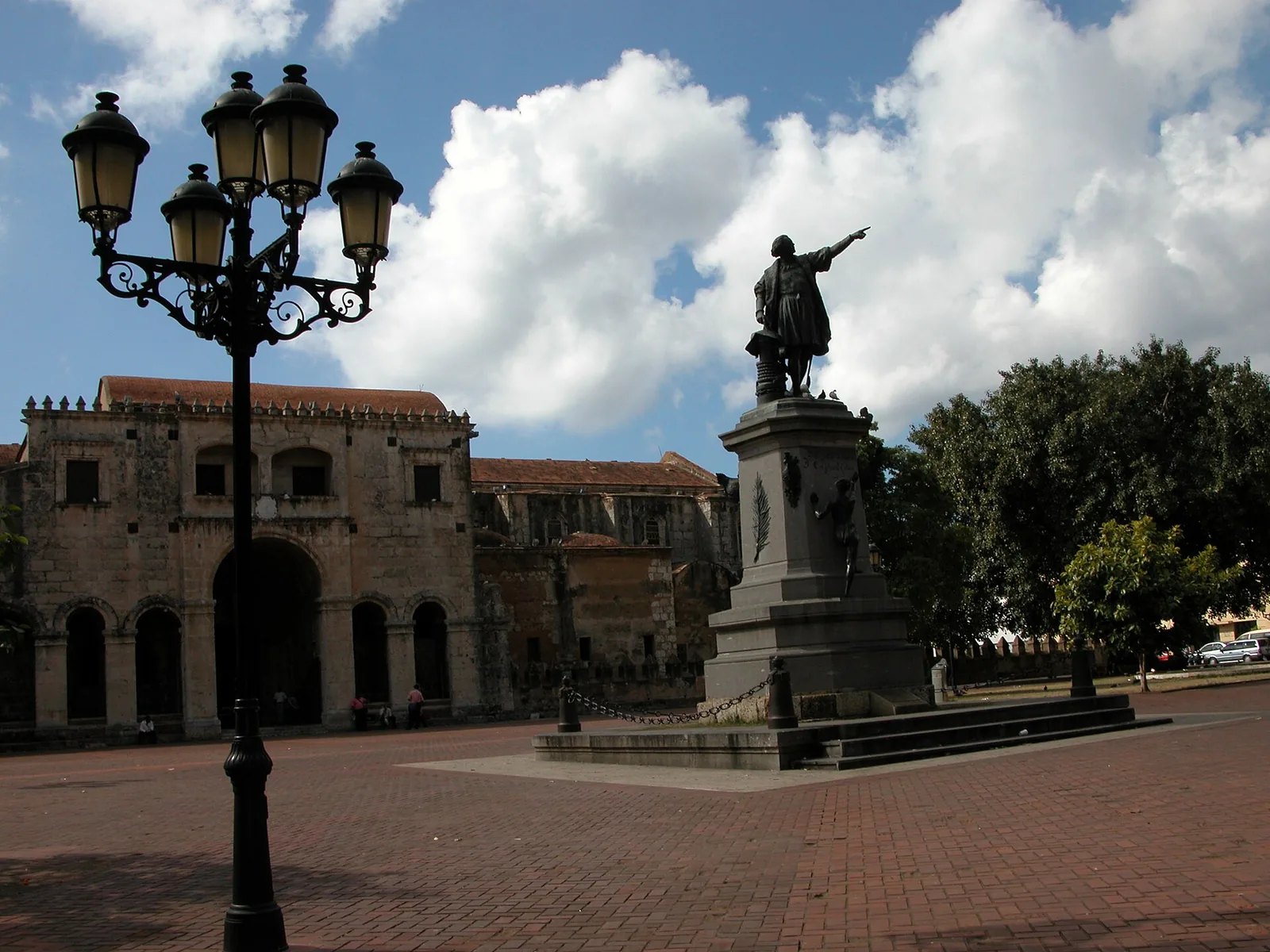
Santo Domingo, the capital of the Dominican Republic, puts colonial history, the Caribbean Sea and a big modern city side by side. Its Colonial Zone is a UNESCO World Heritage Site, the Malecón runs along the sea, and just east of the city you can climb down into the caves of Los Tres Ojos National Park. Daytime temperatures run from 24 to 31 °C, and two or three days covers the main sights.
Our apartments sit on the Malecón, with the Caribbean sunrise outside the window and the colonial area 5 minutes away by car. This guide is the overview: what to see and do across a few days, with links to the deeper guides for the old city, the seafront, the food and the music.
How the city is laid out
Santo Domingo is easy to picture once you know a few anchors. The Colonial Zone sits at the mouth of the Ozama River, on its west bank. The Malecón runs west from there along the south shore, past our apartments and on toward the Centro de los Héroes. Inland, the Plaza de la Cultura stands on Avenida Máximo Gómez, and the modern center of Piantini and Naco spreads around Avenida Winston Churchill and Avenida Gustavo Mejía Ricart. Parque Mirador Sur runs along the coast between Avenida Winston Churchill and Avenida Luperón. Across the river, in Santo Domingo Este, are Los Tres Ojos and the Faro a Colón.
The Colonial Zone
The old walled city at the mouth of the Ozama River is where Santo Domingo began. Founded in 1498 and laid out on a grid that became the model for town planners across the New World, it holds the first cathedral, hospital, customs house and university in the Americas, and it has been on the World Heritage List since 1990.
The highlights are a short walk from each other: the Catedral Primada on Parque Colón, Calle Las Damas, the first paved street in the Americas, the Fortaleza Ozama, the oldest European military building in the New World, the Alcázar de Colón on the Plaza de España, the Museo de las Casas Reales and the ruins of the first monastery in the New World.
Parque Colón is the place to start. A tall statue of Columbus stands in the middle with the Taíno heroine Anacaona at his feet, and the square is ringed with sidewalk cafés and merengue players. The old city has many historic churches, and on summer mornings in 2026 the Ruta de los Templos opened them to visitors free of charge.
Give it at least a morning, and a full day if you like museums. Our Colonial Zone guide has the streets, the museums with their opening days, and a plan for a morning and a plan for a full day.
The Malecón
The Malecón, officially Avenida George Washington, is the seafront avenue that runs for roughly 15 kilometers along the south shore of the city. It comes to life at sunset, when residents walk, jog and ride along the water, and its parks, obelisks and monuments date from the 1930s onward.
It is also where the city celebrates: the carnival parades, the February 27 military parade and the big free concerts all take place on the avenue. Our Malecón guide covers sunrise times, the monuments, the parks and the events.
From the apartments, the sun rises over the sea a little after 6 a.m. in June and a little after 7 a.m. in January. When the Dominican team plays a big game, the city puts up giant screens at Plaza Santo Domingo, at the corner of Avenida Abraham Lincoln and the Malecón, and thousands come out to watch together.
The Plaza de la Cultura
The Plaza de la Cultura Juan Pablo Duarte, on Avenida Máximo Gómez, brings the national theater and four museums together around gardens and fountains: the museums of the Dominican Man, Modern Art, History and Geography, and Natural History.
- The Teatro Nacional Eduardo Brito, open since 1973, is the country's leading arts venue, with three halls, the largest seating 1,600, for plays, opera, the National Symphony Orchestra and award shows.
- The Museo de Arte Moderno shows the best of 20th-century Dominican art, along with temporary exhibitions and biennials on architecture and Caribbean art. It is a good stop before you buy art in the galleries.
- The Museo del Hombre Dominicano, opened in 1972 and reopened in 2022 after a four-year renovation, holds pre-Taíno and Taíno pieces and is the place to learn about the island's first people. In 2026 it showed an exhibition on cemíes, dúhos and native rituals.
- The Museo Nacional de Historia y Geografía reopened in April 2026 with seven renovated rooms on the War of Independence, the Restoration War, the presidents, the Trujillo era, the April 1965 revolution and the educator Eugenio María de Hostos.
Parque Iberoamérica
For a shady break in the middle of the city, Parque Iberoamérica surrounds the National Music Conservatory. Renovated in 2012, it has an outdoor gym of 300 square meters, walking paths, a children's playground and an iguana habitat by the entrance.
The Palacio de Bellas Artes
The Palacio de Bellas Artes, a neoclassical building opened in 1956 and restored in 2008, hosts concerts, plays and ballet in halls that seat up to 600. It is also home to the national schools of dance, drama, visual art and music, and to the National Classic Ballet, the National Symphony Orchestra and the National Folkloric Ballet, so check its program for a performance during your stay.
Los Tres Ojos National Park
Los Tres Ojos, "the three eyes," is a nature break just east of the city. A winding staircase leads down into caves, where paths follow three freshwater lagoons, the oval "eyes" that gave the park its name.
A fourth lagoon is reached by a small wooden barge and opens onto open sky, water and rock covered in green vegetation. The Taíno used these caves for refuge and ritual, so keep an eye out for petroglyphs.
The Faro a Colón
The Faro a Colón, the Columbus Lighthouse, is a huge cross-shaped monument on Avenida Mirador del Este in Santo Domingo Este. It holds a mausoleum for Admiral Christopher Columbus and exhibitions contributed by countries from around the world. It opens Tuesday to Sunday, 9 a.m. to 5 p.m.
Los Tres Ojos and the Faro a Colón are both east of the Ozama River, so they pair well in a single morning or afternoon by taxi. On the same side of the river, facing the Colonial Zone, Chencha Espacio Abierto puts on son, guaracha, merengue and boleros by the water.
The National Botanical Garden
The Jardín Botánico Nacional is the largest botanical garden in the Caribbean, with more than 2 square kilometers of the island's native trees, palms and flowers, including more than 300 species of orchid.
A trolley tour takes you around the grounds, and the Japanese garden, with a lawn by the lake, is the favorite spot for a picnic. Bird watchers can look for the palmchat, the national bird.
Parque Mirador Sur
Parque Mirador Sur was Santo Domingo's first recreational park and is still its most popular, a favorite of athletes. It runs for 8 kilometers, parallel to the coast, from Avenida Winston Churchill to Avenida Luperón.
Come early in the morning or in the evening to walk, jog, rollerblade or ride with views of the Caribbean. There are children's playgrounds, an open-air gym, bike and rollerblade rentals and an artificial lake with boat rides. Its Avenida de la Salud hosted the cycling time trial of the 2026 Central American and Caribbean Games.
Art, history and the 20th century
The Museo Bellapart, a private museum on the fifth floor of a Honda building, holds more than 2,000 works by Dominican artists of the 19th and 20th centuries, including the most complete collection of the modernist painter Jaime Colson.
In the Colonial Zone, the Museo de las Casas Reales walks through Dominican history from 1492 to the first independence from Spain in 1821, the Casa del Cordón shows a collection of Taíno artifacts called Our First Inhabitants, and the Museo de las Atarazanas Reales tells the island's story at sea in the old royal shipyard.
Nearby, the Museo Memorial de la Resistencia Dominicana tells the story of the Trujillo dictatorship and the people who resisted it, including the murder of the Mirabal sisters in 1960.
Along the Malecón, the Obelisco Macho was put up in 1937 to mark the renaming of the city as Ciudad Trujillo, and artists have since covered it with murals, including one of the Mirabal sisters.
A walk through Dominican independence
For guests who want the story of the country's founding, follow the independence trail. Start at the Casa de Duarte on Calle Isabel la Católica, with the personal belongings of Juan Pablo Duarte, then walk to the Panteón de la Patria on Calle Las Damas, where national heroes rest under an honor guard.
Finish at the Puerta del Conde, where Francisco del Rosario Sánchez raised the flag on February 27, 1844, and step through into Parque Independencia to the Altar de la Patria, which holds the remains of Duarte, Sánchez and Mella.
A walk through the Trujillo years
The dictatorship of Rafael Leónidas Trujillo left its mark on the seafront, where the Malecón itself was built in the 1930s. On the avenue, the Obelisco Macho marks the 1936 renaming of the capital as Ciudad Trujillo, the Parque Eugenio María de Hostos opened as the Parque Ramfis Trujillo, and the Ministry of Culture building began as the palace of his party. The Palacio de Bellas Artes was built in the same years.
To understand the period, visit the Museo Memorial de la Resistencia Dominicana in the Colonial Zone and the room called Trujillo, una era de terror, at the Museo Nacional de Historia y Geografía.
Chocolate, amber and larimar
Three Dominican products make good things to take home: cacao, amber and larimar. In the Colonial Zone, the Kahkow Experience on Calle Las Damas tells the story of Dominican cacao.
The Amber World Museum and the Larimar Museum, also in the Colonial Zone, explain the island's amber and the blue larimar found only in the Dominican Republic. Visit them before you buy jewelry so you know what to look for.
Shopping
Calle El Conde, the first commercial street in the New World, is the pedestrian shopping street of the Colonial Zone, with souvenir shops, cafés and street painters along more than 10 blocks. The side streets have art galleries and craft shops selling Dominican paintings, textiles, and amber and larimar jewelry.
For malls, the city has Ágora Mall, Blue Mall, Sambil Santo Domingo, Downtown Center, Acrópolis Center and Galería 360. The big malls and supermarkets open on Sunday from 9 a.m. to 8 p.m., when most other shops are closed.
Cigar shops are part of the city too, including lounges where you can watch a roller at work and pair a cigar with a cocktail.
Dominican food
Dominican cooking mixes Taíno, African and Spanish roots: rice and beans, plantains, stews, fried fish and fresh juices. Start the day with mangú, mashed green plantain, have la bandera, rice, beans and stewed meat, for lunch, and try sancocho, the stew of up to seven meats.
Our Dominican food guide explains the dishes, the drinks and the rum, and lists long-running places to eat near the Malecón and in the Colonial Zone.
Two easy starting points: Adrian Tropical, on the sea at Avenida George Washington 1, open 24 hours with mangú for breakfast, and Jalao on Parque Colón, with Dominican food and live merengue and bachata.
Music and nights out
The Dominican Republic gave the world merengue and bachata, both now on UNESCO's intangible heritage list. One of the most beloved musical traditions in the city happens every Sunday: Grupo Bonyé playing son, salsa and merengue in the Ruinas de San Francisco from 5 p.m.
The nightlife and music guide covers live music in the Colonial Zone, the theaters, the Malecón after dark, the casinos and the big nights of the year.
In summer, Casa de Teatro holds the Santo Domingo Jazz Festival on Thursday evenings, and on December 11 and 12, 2026, the Festival Presidente returns to the Estadio Olímpico Félix Sánchez with Juan Luis Guerra 4.40, Katy Perry, Don Omar and Calvin Harris.
Active days
Santo Domingo is a good city for an early workout. The Malecón has marked lanes for bikes and rollerblades along the sea, Parque Mirador Sur has 8 kilometers of paths, and the new Malecón Deportivo, opened in April 2026, stretches nearly two kilometers along the seafront with courts for football, beach volleyball, 3x3 basketball and padel, plus a skatepark.
With children
Families have plenty of choice. The Museo Infantil Trampolín, an interactive children's museum in the 16th-century Casa Rodrigo de Bastidas on Calle Las Damas, opens Tuesday to Friday from 8:30 a.m. to 4 p.m. and on weekends from 9:30 a.m. to 5:30 p.m.
Outdoors, try the boat ride across the fourth lagoon at Los Tres Ojos, the trolley at the Botanical Garden, the lake and playgrounds at Mirador Sur, and the rides at Plaza Juan Barón on the Malecón.
For couples
For a couple on a city break, the sunrise from the apartment and the sunset walk on the Malecón bookend the day. In the Colonial Zone, Plaza María de Toledo is a favorite with couples for a quiet moment, and the Plaza de España at sunset is one of the most romantic places in the city for dinner. On Sunday, dance together at the Ruinas de San Francisco.
For business travelers
Several of the big hotels on the Malecón double as meeting and convention centers, and the hotel bars of Piantini and Naco fill with after-work crowds from Wednesday on. A morning run on the Malecón or in Mirador Sur clears the head before the first meeting.
On a rainy or very hot afternoon
Head indoors: the museums of the Plaza de la Cultura, the Museo de las Casas Reales and the Alcázar de Colón, the Kahkow Experience or the malls. In the evening, catch a performance at the Teatro Nacional or the Palacio de Bellas Artes.
Baseball
Baseball is part of Dominican sporting and cultural life, and the Estadio Quisqueya, on Avenida Tiradentes, is home to two rival teams, the Tigres del Licey and the Leones del Escogido, with easy access from most of the city's hotels.
Beaches and day trips
Santo Domingo is a city, so for swimming and sand you head out of town, and for longer outings there are day trips across the region. Rum lovers can visit the Ron Barceló Historic Center in San Pedro de Macorís, a museum of the history of rum opened in 2012, with barrel warehouses and a tasting bar.
Our Santo Domingo guides cover the beaches near the city, the best day trips, getting around and the best time to visit.
The year in Santo Domingo
Some dates shape a visit:
- January 21, the day of Our Lady of Altagracia, and January 26, Duarte's birthday, both public holidays.
- February: carnival, with the city parade and the national parade on the Malecón, and the Mes de la Patria from January 26 to March 9.
- February 27: Independence Day, with a ceremony at the Altar de la Patria and a military and police parade on the Malecón.
- Holy Week, when families travel home and eat habichuelas con dulce.
- June: the Fiesta de la Música, with free concerts, and the start of the Santo Domingo Jazz Festival at Casa de Teatro, which runs on Thursdays in June and July.
- Summer: the Turizoneando program of concerts and museum nights in the Colonial Zone, held from June 20 to August 30 in 2026.
- August 16, Restoration Day, and September 24, the day of Our Lady of Las Mercedes.
- November 6, Constitution Day, and November 26, National Merengue Day.
- December: Christmas, with roast pork on Christmas Eve, the Festival Presidente on December 11 and 12, 2026, and a free New Year's Eve party on the Malecón.
Planning your days
A first day belongs to the Colonial Zone. Start at Parque Colón and the Catedral Primada, walk Calle Las Damas to the Fortaleza Ozama, and have lunch on the Plaza de España. In the afternoon, walk Calle El Conde to the Puerta del Conde, and come back to the Malecón for sunset.
A second day can start with the sunrise from your window and a walk on the Malecón, then head inland to the Plaza de la Cultura for the museums, or east to Los Tres Ojos and the Faro a Colón. Finish with dinner and live music in the Colonial Zone.
A third day is for the Botanical Garden, shopping, a beach day or a game at the Estadio Quisqueya. If one of your days is a Sunday, save the evening for Grupo Bonyé at the ruins.
Practical notes
Many museums close on Monday. The Alcázar de Colón, the Faro a Colón, the Atarazanas Reales and the Casa de Duarte all open Tuesday to Sunday, so plan Monday for churches, plazas, the Larimar Museum and the Malecón.
Dress for the city rather than the beach, especially for churches; the sun is strong even on cloudy days, so carry sunblock and water, and drink bottled water, sold at colmados and supermarkets.
Restaurant bills include a 10% service charge plus the 18% ITBIS sales tax, and it is customary to leave another 10%. Carry pesos in small amounts and leave your passport and the rest of your cash in the apartment.
At night, use a taxi recommended by your host, hotel or restaurant. For emergencies, dial 911, and the tourist police, CESTUR, are trained to help visitors.
Spanish is the official language, spoken fast, and English is widely spoken in the tourist areas.
The currency is the Dominican peso, written RD$. US dollars and euros can be exchanged at banks and authorized exchange offices, and ATMs are widely available; choose one indoors and use it during the day.
The electricity is 110 volts, so visitors from the United States and Canada can plug in without adapters, while visitors from Europe will need them. For a local phone number, a SIM card from Claro or Altice needs an unlocked phone and your passport.
When the day is done, our apartments on the Malecón bring you back to the sea.