
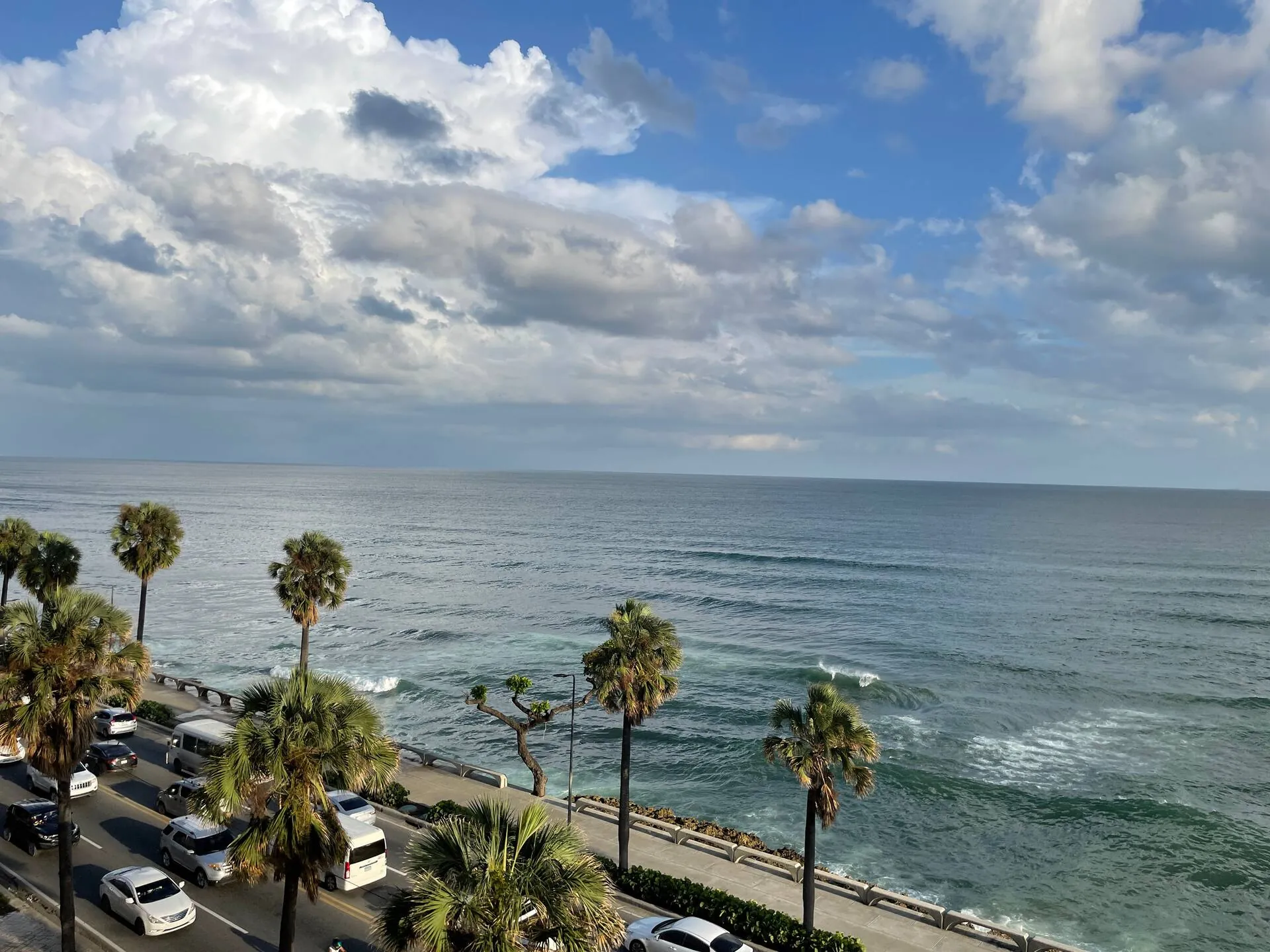
The Malecón is Santo Domingo's seafront avenue, officially Avenida George Washington. The Caribbean Sea runs along one side and hotels, restaurants and nightlife line the other, and it played a key part in the city's selection as Culture Capital of the Americas in 2010.
Our apartments look out over this stretch of sea, and one of our listings sums it up: enjoy the Caribbean sunrise from your bed. This guide covers the promenade itself, the sunrise and sunset, the monuments and plazas along the water, the events that close the avenue to traffic, and how to walk, run or ride it.
What the Malecón is
The avenue runs for roughly 15 kilometers along the south shore of the city. People come to walk, jog and ride bikes, or just to sit in one of the seafront parks, such as the Playa de Güibia park and the Plaza Juan Barón.
The Malecón comes to life in the afternoon at sunset and keeps going into the night. Residents stroll its length for the evening breeze, past two historic obelisks, and the seafront parks have esplanades and benches facing the water.
In Dominican Spanish, a malecón is a promenade that runs along the edge of the sea or a river, and the word also means the sea wall built to hold back the water.
A renovation in 2017 added marked lanes for bikes and rollerblades, more esplanades, and more seating along the sea, and the promenade has been livelier ever since.
How the seafront avenue was built
Before the avenue existed, the shore here held the city's slaughterhouse and its dump. The first seafront walk came in 1911: the Paseo Presidente Billini, a short avenue near the mouth of the Ozama River, between Calle 19 de Marzo and Calle Espaillat, with two lanes divided by a row of almond trees and benches.
In 1930 the engineer Ramón Báez López proposed an avenue along the whole coast of the city. Owners of seaside houses objected, since they would lose land and their private access to the sea, but the city's Junta de Ornato ordered work on the first stretch to begin at the end of 1931.
The avenue opened in February 1936 under the name George Washington, timed to the birthday of the first president of the United States. It became the city's great public space, and the public events of the Trujillo years ended with a march or a parade along the Malecón. The obelisks, the Parque Eugenio María de Hostos and the palace of the ruling party followed.
Sunrise and sunset over the Caribbean
The Malecón faces the open Caribbean, and from our apartments the sun comes up over the sea. One of our listings suggests a coffee with the sunrise, and that is the way to start a day here.
Sunrise times move with the seasons, so set your alarm by the month. The sun comes up earliest in June, a little after 6 a.m., and latest in January, after 7 a.m. Sunset runs from just after 6 p.m. in December to past 7 p.m. in June, so summer evenings on the promenade stay light longer.
| Mid-month | Sunrise | Sunset |
|---|---|---|
| January | 7:14 a.m. | 6:25 p.m. |
| March | 6:47 a.m. | 6:50 p.m. |
| June | 6:02 a.m. | 7:18 p.m. |
| September | 6:26 a.m. | 6:43 p.m. |
| December | 7:03 a.m. | 6:07 p.m. |
For a sunrise photo, be at the window or on the promenade about 20 minutes before the times above, when the sky first starts to brighten over the water. In mid-June the first light comes at about 5:39 a.m., and in mid-January at about 6:51 a.m.
For sunset, walk out onto the promenade itself. That is the hour when the Malecón comes to life and the evening crowd starts to arrive.
Walking, running and cycling
The promenade is made for an early walk or run. The marked lanes for bikes and rollerblades keep riders apart from people on foot, and the esplanades and seating give you places to stop and look at the water.
The best hours are early morning, before the sun gets high, and late afternoon into the evening. The sun is strong even on cloudy days, so wear sunblock and a hat, and carry water: bottled water is sold in the colmados, the corner stores you will see across the city.
The most comfortable months for a long walk are December through early March, when mornings and evenings bring cool breezes and daytime temperatures sit around 25 to 27 °C (77 to 80 °F). From April to October the days are warmer and more humid, with afternoon highs near 32 °C (90 °F), so head out early.
Heading east from our part of the Malecón toward the old city, you pass the Playa de Güibia park first, then the Parque Eugenio María de Hostos with the Obelisco Macho beside it, then the Plaza Juan Barón, and then the old Fuerte San Gil with the Obelisco Hembra close by, at the edge of the Colonial Zone. A walk to the old city and a taxi back makes a good morning.
Running events use the avenue too. Marathons, cultural fairs and food fairs are all held on the Malecón, so it is worth checking the city's calendar if you plan an early run on a weekend.
When Santo Domingo hosted the Central American and Caribbean Games in 2026, the marathon and the race walk started on Avenida George Washington at 6 a.m., and the road cycling races used the avenue as well. The Malecón Deportivo, the sports grounds by the sea, held the beach volleyball, the 3x3 basketball and the street skateboarding, and the Paseo 30 de Mayo has a speed skating track.
The two obelisks
The Obelisco Macho was put up in 1937 to celebrate the renaming of Santo Domingo as Ciudad Trujillo during the dictatorship. The change of name dated from January 11, 1936, and the nickname "macho" comes from its shape.
After the dictatorship ended, the obelisk became a canvas for Dominican artists. Painters including Cándido Bidó, Amaya Salazar and Dustin Muñoz have covered it with murals of Dominican identity, among them the Mirabal sisters, who were murdered under Trujillo in 1960.
After more than 10 years in the dark, the obelisk was lit again in 2022, when the city government and Banreservas replaced its lighting, added new signs and repainted the ground around it. It is lit at night.
The Obelisco Hembra, also called the Monumento a la Independencia Financiera, celebrates the end of the country's foreign debt to the United States during the Trujillo regime. It is made of two monoliths and stands close to the old Fuerte San Gil, at the edge of the Colonial Zone.
Parque Eugenio María de Hostos
Next to the Obelisco Macho is the Parque Eugenio María de Hostos. It opened in 1937 as the Parque Ramfis Trujillo, and after the dictatorship it was renamed for Hostos, the Puerto Rican educator who did much of his life's work in the Dominican Republic.
The park covers 19,568 square meters, with a children's play area of about 2,000 square meters, a large central fountain and common areas for families. Hostos also founded the Normal School that met in the Chapel of the Third Order of the Dominicans, in the Colonial Zone.
Near it is the Ministry of Culture, in a building first put up as the palace of the Partido Dominicano, the party Trujillo founded and the only political organization allowed in his time.
Plaza Juan Barón and Güibia
Plaza Juan Barón is the Malecón's family park, with rides for children, fast-food stands and, at night, karaoke. It is a favorite with Dominican families on an evening out.
Güibia has been the capital's beach for a very long time. In the 1860s, during the annexation to Spain, bathing there needed the governor's express permission. In the 1940s the architects Guillermo González and José Antonio Caro built the Casino de Güibia there, a social club with tables for games, a bar, showers, swimsuit rentals and dance halls. In the 1960s and 1970s young people came to Güibia for swimming lessons and to surf the waves.
Today Güibia is one of the seafront recreation parks on the Malecón, with esplanades and places to sit by the water. In the evening, El Corito Bachatero gathers people to dance bachata across from the Playa de Güibia, an event that began in August 2023 because its founder wanted more places to dance.
For a swim, head to one of the beaches outside the city; our beaches guide covers them.
The Fray Antón de Montesinos monument
Near the port stands the monument to Fray Antón de Montesinos, a statue of bronze and limestone 15 meters tall. It honors the Dominican friar who spoke out publicly against the enslavement of the native people of the island.
Montesino's appeal for the natural rights of the native people was made in Santo Domingo, and it is remembered as the start of the fight for basic human rights in the Americas. Many of the visitors who stop at the statue come in through the nearby port.
From here the Colonial Zone is close by, and the walk from the Malecón into the old city is an easy one. The old city is bordered by walls, bastions and forts, and the Fuerte San Gil stands right on the seafront at its edge.
Plaza Santo Domingo and the big screen
Plaza Santo Domingo, at the corner of Avenida Abraham Lincoln and the Malecón, is where the city gathers to watch big games together. During the 2026 World Baseball Classic the city government put up giant screens there for the Dominican team's games, and thousands came out to cheer; it did the same for Marileidy Paulino's race at the Paris 2024 Olympics. If a big game falls during your stay, this is the place to watch it with the whole city.
The Malecón Deportivo
The newest stretch of the seafront is the Malecón Deportivo, a sports promenade opened in April 2026 along nearly two kilometers of the south shore. It covers 90,000 square meters in four zones, with courts and fields for football, beach volleyball, 3x3 basketball and padel, a skatepark, and solar-powered LED lighting for the evening.
It was designed by the architect Luis Alejandro Pérez and built in time for the 2026 Central American and Caribbean Games, and the President has proposed designing a renovation of the rest of the Malecón as far as Avenida Luperón. Bring sneakers if you want to use the courts.
Finding your way along the avenue
Cross streets make the easiest landmarks when you give directions. Plaza Santo Domingo sits at Avenida Abraham Lincoln, the Centro de los Héroes is on Avenida Jiménez Moya to the west, Güibia lines up with Avenida Máximo Gómez, and the Fuerte San Gil and the Obelisco Hembra mark the start of the Colonial Zone.
With children
Families have plenty to do on the Malecón. Plaza Juan Barón has rides and fast-food stands, the Parque Eugenio María de Hostos has a children's play area of about 2,000 square meters around a big fountain, and the Malecón Deportivo has courts and a skatepark that hosted beach volleyball, 3x3 basketball and street skateboarding at the 2026 Central American and Caribbean Games.
Go in the early evening, when the heat drops and local families come out too, and bring water and a snack from a colmado on the way.
Photographs along the Malecón
For the sunrise from the apartment window, check the sunrise table above and have the camera ready. Out on the promenade, the painted Obelisco Macho, the Montesinos statue and the old Fuerte San Gil at the edge of the Colonial Zone all make good subjects, and the obelisk is lit at night.
Centro de los Héroes
West of our apartments, at the Centro de los Héroes, stands the Pabellón de las Naciones, which locals call "la bolita del mundo," the little globe. The dictator had it built to mark 25 years in power.
Hotels, casinos and restaurants on the sea
Several of the city's big hotels stand on the Malecón, among them the Catalonia Santo Domingo and the Renaissance Santo Domingo Jaragua Hotel and Casino. They make handy landmarks when you give a taxi driver directions.
For business travelers, these hotels double as meeting and convention centers, with rooms for corporate events. Staying on the Malecón puts you close to them, with an early run on the promenade before the first meeting.
Most of Santo Domingo's casinos are along the Malecón, inside the hotels. Expect slot machines, roulette, blackjack, craps, mini-baccarat and poker tables, often with merengue playing. The Renaissance Santo Domingo Jaragua is one of the casino hotels on the seafront.
For a Dominican meal by the water, Adrian Tropical sits right on the sea at Avenida George Washington 1. The building was designed to look like a cruise ship, it is open 24 hours a day, every day, except Wednesdays from 3 to 7 a.m., and breakfast with mangú is served from 7 to 11 a.m. More places to eat are in our Dominican food guide.
The menu covers the Dominican classics: sancocho, mofongo of fried mashed plantain with pork crackling, fish Boca Chica style with yaniqueque, fish Samaná style in a coconut milk sauce, and fresh juices such as passion fruit, papaya and mamey sapote.
Events on the Malecón
The Malecón is where Santo Domingo celebrates. The Carnaval de Santo Domingo, the February 27 military parade for Independence Day, and large year-end concerts are all held on the avenue.
Carnival season comes in February, and the city's own parade comes first. The Carnaval del Distrito Nacional took over the Malecón on Sunday, February 22, 2026, from 3 p.m., with more than 70 comparsas, the costumed carnival groups, and a closing concert with Toño Rosario, Omega and Jandy Ventura. The avenue was closed between Avenida Pasteur and Calle Palo Hincado from the Friday afternoon before, while the stands went up.
The national parade follows. In 2026 the Desfile Nacional de Carnaval brought close to 180 comparsas from every province, more than 9,000 dancers, musicians, artists and craftspeople, and visiting groups from Colombia, Brazil, Ghana and Puerto Rico. The 2026 parade was dedicated to Puerto Plata and its taimáscaro character. Look for the diablos, the lechones and the robalagallina, the masked characters of Dominican carnival; some, like the robalagallina, grew up in the capital's own neighborhoods.
Independence Day, February 27, starts with a ceremony at the Altar de la Patria and continues with the military and police parade on the Malecón, with ground units, aircraft overhead and military bands. Find a spot on the promenade early if you want to watch.
In 2026 the avenue was closed to traffic from 6 a.m. on parade day between Avenida Héroes de Luperón and the Puente Flotante, so allow extra time if you are driving that morning.
February is also the heart of the Mes de la Patria, the month of the homeland, which runs from Duarte's birthday on January 26 to Sánchez's birthday on March 9.
The city government also puts on free concerts on the esplanade of the Malecón Deportivo. For Mother's Day weekend in 2026, Grupo Bonyé played there on the Friday evening, with live music from 5 p.m., and the Big Band Dominicana played the Saturday from 6 p.m.
New Year's Eve brings a free party to the avenue. For the end of 2025, the television channel Telemicro held its Gran Fiesta de Fin de Año on Avenida George Washington, one of the two free year-end concerts in the country that night.
A morning on the Malecón
Wake up for the sunrise, make coffee in the apartment, and watch the sea from the window. Then head out before 8 a.m., while it is cool, and walk east along the promenade past Güibia, the Parque Hostos and the obelisk.
Stop for breakfast at Adrian Tropical, where the morning menu runs from 7 to 11 a.m. Order mangú with los tres golpes: cheese, eggs and salami alongside mashed green plantain.
After breakfast, keep walking toward Güibia and the Plaza Juan Barón, or take a taxi on to the Colonial Zone, 5 minutes away by car, to start sightseeing before the midday heat.
An evening on the Malecón
Go out about an hour before sunset and walk west or east along the water as the light changes. By dark the promenade fills with people out for the evening breeze, joggers and cyclists.
Dinner can be as simple as a plate of Dominican food at Adrian Tropical or as dressed-up as a hotel restaurant. Dominicans dress up when they go out in the evening, so pack a nicer outfit for dinner.
After dinner, there is karaoke at Plaza Juan Barón, bachata dancing near Güibia, or a casino in one of the hotels. Our nightlife and music guide covers the rest of the city after dark.
A Sunday on the Malecón
Most offices and shops close on Sunday, which makes Sunday morning a good time for a long walk or ride along the promenade before the heat builds. If you need groceries, the big malls and supermarkets still open on Sunday, from 9 a.m. to 8 p.m.
In the late afternoon, take a taxi to the Ruinas de San Francisco in the Colonial Zone, where Grupo Bonyé plays son, salsa and merengue every Sunday from 5 p.m. Come back along the sea after dark, when the Malecón is lit and still full of people.
Staying on the Malecón
Another listing names the advantage of staying here: you can walk along the water at sunset, eat at nearby restaurants and enjoy the city's nightlife without worrying about transportation.
Practical tips
Restaurants usually serve until 10 p.m. to midnight from Sunday to Thursday and until 2 a.m. on Friday and Saturday. Bills include a 10% service charge plus the 18% ITBIS sales tax, and it is customary to leave another 10% for your server.
Carry Dominican pesos in small amounts for snacks and drinks at the plazas, and leave your passport and the rest of your cash in the apartment.
On parade days, sections of the avenue close to cars. Plan your taxi pickups for a side street, or walk to where traffic is moving.
When you want the sea outside your window and the promenade outside your door, our apartments on the Malecón put you right there.