
Dominican cooking grew out of Taíno, African and Spanish kitchens, and later arrivals added their own dishes, among them the Lebanese, Syrian and Palestinian families who settled in the country in the early 20th century. The result is a cuisine of rice and beans, plantains and root vegetables, stews, fried fish and fresh fruit, seasoned with a sazón of oregano, garlic, onion, peppers, tomatoes, capers and olives.
Santo Domingo is a city that eats out. Restaurants serve breakfast, lunch deals and late dinners, and they cluster in four areas: Naco and Piantini in the modern center, the Malecón, Chinatown and the Colonial Zone. The Malecón is one of them, and the Colonial Zone is 5 minutes away by car.
This guide covers what to order from breakfast to dessert, what to drink, and a short list of long-running places near the Malecón and in the Colonial Zone, with hours and how tipping works.
How a Dominican day of eating works
The breakfast to know is mangú, a mash of green plantain, with eggs, cheese and salami on the side. At midday the plate to know is la bandera, rice and beans with stewed meat, and on special occasions families gather around a pot of sancocho.
Many restaurants offer lunch deals at midday. Dinner runs late. Restaurants usually serve food until 10 p.m. to midnight from Sunday to Thursday and until 2 a.m. on Friday and Saturday, and the city socializes into the early hours.
Snacks fill the gaps: crisp fried yaniqueques, Arab-style quipes, and fresh juices from passion fruit, papaya or mango. You will find all three on the Adrian Tropical menu on the Malecón.
Reading a Dominican menu
Many restaurants print their menus in Spanish first. These are the words you will meet most often, with their English names:
| On the menu | In English |
|---|---|
| Mangú | Mashed green plantain |
| Mofongo | Fried mashed plantain with pork crackling |
| Tostones | Fried green plantain |
| Yuca | Cassava |
| Longaniza | Dominican sausage |
| Chicharrón | Pork crackling |
| Asopao | Chicken or shrimp and rice stew in creole sauce |
| Chivo guisado | Goat stew |
| Bacalao | Codfish |
| Arenque | Herring |
| Quipe | Kibbe |
| Chinola | Passion fruit |
| Lechosa | Papaya |
| Zapote | Mamey sapote |
| Majarete | Corn pudding |
"Criollo" or "a la criolla" on a menu means cooked Dominican style. A fish fillet at Adrian Tropical can come griddled, steamed, with garlic, grilled or Dominican style, and Jalao's criollo shrimp come in a tomato sofrito.
Breakfast with mangú and los tres golpes
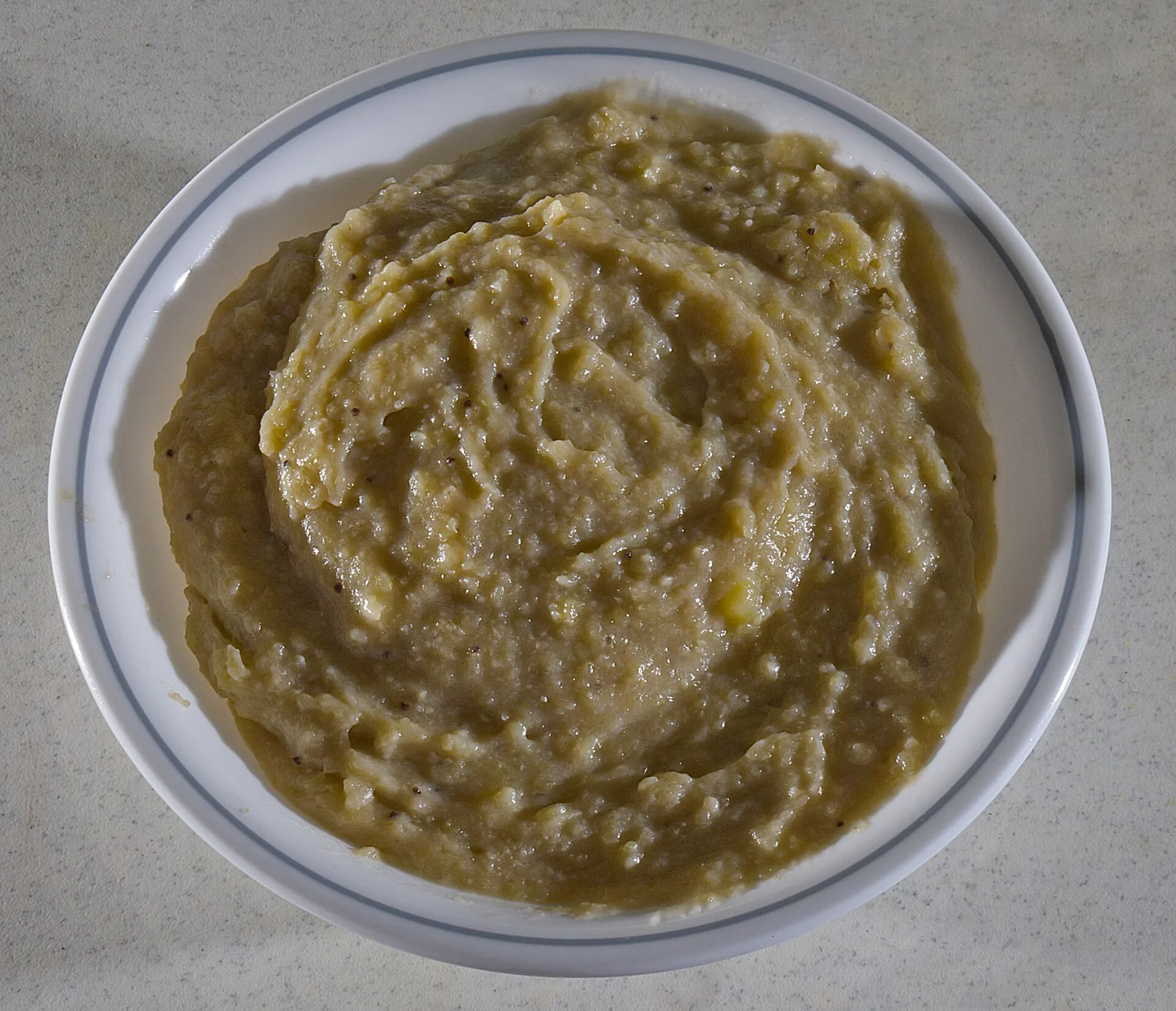
Mangú is a purée of boiled green plantain mashed with oil or butter. The word is used in the Dominican Republic, Puerto Rico and the United States, and in Santo Domingo mangú is the classic breakfast.
The full order is mangú con los tres golpes, "the three hits": cheese, eggs and salami alongside the plantain. At Adrian Tropical on the Malecón you can also have the same three sides with boiled yuca or with guineítos, small green bananas, instead of plantain, and breakfast is served every day from 7 to 11 a.m.
Dominican breakfast menus go well beyond mangú. The same menu lists cocido and mondongo stews, chicken soup, longaniza sausage, salt cod and herring for the morning, along with omelets and scrambled eggs made to order.
To drink, order a café con leche, a cortadito, a medio pollo, which is coffee with a touch of milk, a café de greca or a hot chocolate.
La bandera
La bandera dominicana, "the Dominican flag," is the classic lunch: white rice, beans and stewed chicken, beef or pork. The name comes from the colors on the plate, with the beans for red, the rice for white and the meat for the third color.
Every kitchen has its own version. At Jalao in the Colonial Zone, La Bandera comes with beef cooked with onions, chicharrón, longaniza sausage, red beans, white rice, ripe plantain and avocado.
Rice dishes go beyond the bandera. A locrio is rice cooked together with meat, and arroz con pollo is Dominican-style rice cooked with chicken. An asopao is a soupy stew of chicken or shrimp and rice in a creole sauce.
Moro de guandules is another rice to try; at Jalao it comes with the wine-braised goat.
Sancocho and the other stews
Sancocho is one of the best-known Dominican dishes, a stew of meat, yuca, plantain and other roots and vegetables. The Dominican version stands out for using as many as seven different meats, and it is the dish families make for special occasions.
Restaurants serve it with white rice on the side. Adrian Tropical calls its version the Sabrococho, and Jalao makes its sancocho with mixed meats and root vegetables.
Other stews worth ordering:
- Mondongo, a stew of tripe and trotters with carrot, potato and chickpeas.
- Chivo guisado, goat stew, a specialty on both the Adrian Tropical and Jalao menus; Jalao braises it in wine and serves it with moro de guandules.
- Cocido, a hearty Dominican stew served with rice, yuca or tostones.
- Bacalao, salt cod, and arenque, herring, both cooked Dominican style.
Plantains, yuca and mofongo
Mofongo is fried green plantain mashed in a mortar with garlic, olive oil and pork rinds. Its origins are African, it is on almost every Dominican restaurant menu, and it can also be made with yuca, ripe plantain or yams. The mix of yuca, green plantain and ripe plantain is called trifongo.
Fillings change from place to place. Adrian Tropical serves mofongo with pork crackling, a shrimp version called camarofongo, and one with fried herring, and it can make the mash with ripe plantain, green bananas or yuca on request.
Tostones, crunchy fried green plantain, are the classic partner for fried fish. Sweet ripe plantain, plátano maduro, shows up on the side of a bandera, and fried yuca is another side to try.
Casabe, the flat bread made from cassava flour, is one of the country's signature products, and it turns up as small toasted casabitos served with chicharrón at Jalao.
Fish and seafood
Crispy fried fish with green plantain tostones is the beach meal of the Caribbean coast, served on the sand with the catch of the day. In Santo Domingo you can order it Boca Chica style, after the beach town: at Adrian Tropical it comes with yaniqueque, and at Jalao it comes seasoned with oregano, garlic and lime, with sweet potato fries, tostones and small yaniqueques.
From Samaná comes fish in coconut sauce. Coconut and ginger are the key ingredients of Samaná's kitchen, and Adrian Tropical serves its Samaná-style fish in a coconut milk sauce.
Grilled octopus has become a Dominican restaurant favorite, served as a starter. Shrimp comes criollo style in a tomato sofrito with tostones, or in rice. Adrian Tropical also makes a seafood rice, a seafood medley and a seafood soup served with bread.
To eat fish with your feet in the sand, our beaches guide covers the beaches near the city.
Street food and snacks
The snacks are where Dominican food gets fun:
- Yaniqueque, a crisp fried dough made with wheat flour, made Boca Chica style.
- Quipe, the Dominican kibbe, listed as quipe árabe on menus, one of the dishes the Lebanese and Syrian families added to Dominican food.
- Catibías, filled with pork, cheese or beef.
- Chimi, the Dominican burger, made with chimi meat, green tomato, cabbage and pink sauce.
- Chicharrón, crisp fried pork, served with casabitos.
- Pastelitos and croquetas, small fried pastries and croquettes filled with cheese, chicken, shrimp or goat.
Sweets and desserts
Dominican desserts lean on milk, coconut and corn. Look for majarete, a creamy pudding of young corn with cinnamon, flan de coco, coco al horno, baked coconut, tres leches and the richer cinco leches, and bread pudding with ciruela. Also look for leche cortada, a sweet milk curd, and oranges in syrup.
Habichuelas con dulce is the sweet bean dessert of Holy Week. It is the typical treat of the Easter season, when Dominicans travel home to their families.
At Christmas the tradition is pork. On Christmas Eve families roast a whole pig in the backyard through the night, listening to music and sharing drinks, and the party goes on until the meat is ready at dawn.
Fruit and fresh juices
Fresh juices are a big part of Dominican menus. Adrian Tropical alone lists passion fruit, called chinola, lime, pineapple, mango with passion fruit, mamey sapote, which Dominicans call zapote, granadillo, papaya, called lechosa, melon, strawberry and orange, and it blends them into combinations: the Frechiza is strawberry, passion fruit and carrot, and the Combinación Tropical mixes eight fruits and carrot in one glass.
Ask for the Dominican names when you order: chinola for passion fruit, lechosa for papaya, zapote for mamey sapote.
Morir soñando is a sweet drink that tastes like a creamsicle. Jalao even pairs it with its shrimp ceviche.
Drink bottled water rather than tap water. Colmados, the corner stores, and the supermarkets sell it.
Coffee and chocolate
On a Dominican menu you will find coffee several ways: a plain café, a cortadito, a café con leche or a café de greca, with hot chocolate alongside.
Coffee, cassava bread, honey and cocoa are among the products the country is known for, and visitors can follow each of them back to the farms. Cacao is one of the Dominican Republic's top four exports, grown in several parts of the country, with the northern region the best known for it.
In the Colonial Zone, the Kahkow Experience is a cacao and chocolate center on Calle Las Damas where the story of cacao in the Dominican Republic is told. Kahkow chocolate comes from a Dominican cacao family business that dates back to 1905, and its bars include a Colonial Monuments edition.
Rum, beer and mamajuana
Rum is made here, and two of the big names have long histories. Ron Bermúdez traces its history to 1852, at the start of the Dominican Republic itself, and calls itself the first Dominican rum. Ron Barceló, based in San Pedro de Macorís, is made from the juice of sugarcane grown in its own fields.
If you want to see how it is made, the Ron Barceló Historic Center in San Pedro de Macorís, opened in 2012, is a museum of the history of rum in the country, with the barrel warehouses, a tasting bar and a shop.
Presidente, the leading beer of the Cervecería Nacional Dominicana, is the one Dominicans reach for at a celebration.
Mamajuana is popular with visitors. It is made by steeping bark and small pieces of wood, such as palo de Brasil and marabelí, with canelilla leaves, cloves, bejuco indio and star anise in rum, honey and red wine. Its roots go back to Taíno herbal brews, with rum added after the Spanish arrived. The bottles can be refilled, and the dry sticks are sold in travel packs to take home. Some sellers also make a seafood version with octopus, squid and clams added to the usual mix.
Jalao serves its own mamajuana and lists it as the most Dominican drink of all. Try a small glass before you buy a bottle.
Many visitors take mamajuana home as a souvenir. Look for a bottle with a mix of different sticks inside; sellers point out that bottles with only palo de Brasil do not have the same taste or smell.
Rum also goes into the house cocktails. At Adrian Tropical, the Néctar Caribe mixes rum with passion fruit, lime and orange, and the Suave Diferencia is white rum with lemon-lime soda, lime juice and sugar. At Jalao, El Arretao mixes rum with sugar syrup and bitters, and El Mayimbe is a coconut mojito with mint and lime.
Where to eat near the Malecón
These are long-running places that were open and serving in 2026:
Adrian Tropical, Avenida George Washington 1. A Dominican restaurant right on the sea, in a building designed to look like a cruise ship. It is open 24 hours every day, except Wednesdays from 3 to 7 a.m., and it serves breakfast with mangú from 7 to 11 a.m. The menu runs from sancocho and mofongo to goat stew, Samaná-style fish and fresh juices.
El Conuco, Calle Casimiro de Moya 152, in Gazcue. Opened on April 5, 1991, El Conuco calls itself a piece of the Dominican countryside in the middle of the city. It is open every day from noon to midnight, and its dining rooms face a stage show, some air-conditioned and some open air.
For dinner with a view, the big hotels along the Malecón have their own restaurants, and our Malecón guide has more on the avenue after dark.
Where to eat in the Colonial Zone
Jalao, Calle El Conde 103, on Parque Colón. It calls its cooking 100% D'aquí, one hundred percent from here: Dominican food from the countryside, with live merengue, bachata and perico ripiao in a dining room decorated with painted houses and murals. Open Tuesday to Thursday and Sunday from 11 a.m. to midnight, and Friday and Saturday until 1 a.m. It is closed on Monday unless Monday is a public holiday.
Pat'e Palo, Plaza de España. A European-style brasserie with terrace tables facing the Alcázar de Colón; it gives 1505 as its founding year and calls itself the first tavern of the New World. Open Monday to Wednesday from noon to midnight and Thursday to Saturday from noon to 1 a.m.
The Plaza de España is lined with outdoor terraces, and Parque Colón is ringed with cafés and bars, so there is always somewhere to stop between sights. Our Colonial Zone guide covers the walk itself.
Late-night food
Santo Domingo eats late, and on weekends restaurants keep serving until 2 a.m. If you land on a late flight or come back from dancing hungry, Adrian Tropical on the Malecón is open around the clock, apart from Wednesdays from 3 to 7 a.m.
One of our listings says it well: from the Malecón you can walk along the water at sunset and dine at nearby restaurants without worrying about transportation.
Naco, Piantini and Chinatown
Beyond the Malecón and the Colonial Zone, many of the city's restaurants are in Naco and Piantini, the modern center, along Avenida Gustavo Mejía Ricart and Avenida Winston Churchill. That is where to go for Mexican, Middle Eastern, French, Italian, Spanish, Japanese and Korean food, often with a Dominican twist and local ingredients.
Santo Domingo's Chinatown is the other dining neighborhood on the list, for Chinese food. New restaurants open in the capital every month, so ask your host what is new when you arrive.
A few words for ordering
A little Spanish goes a long way at the table:
- La cuenta, por favor: the check, please.
- Un jugo de chinola: a passion fruit juice.
- Una Presidente bien fría: a very cold Presidente.
- Sin hielo: without ice.
- ¿Qué me recomienda?: what do you recommend?
Dominicans speak fast and often skip the final s, so Las Terrenas comes out as "La Terrena." English is widely spoken in the tourist areas, so you can switch to English if you get stuck.
Vegetarian and children's choices
Dominican cooking leans on meat, but some restaurants plan for other diets. Adrian Tropical has a section of alternative dishes: mofongo made with soy and served with mushroom broth, a mofongo with plant-based ham, mushrooms and cashews, vegetable soup and vegetable cannelloni.
For children, the same menu has a kids' section with a hamburger and fries, cheese fries, penne in tomato sauce and a dish called chichapollito.
A day of eating in Santo Domingo
Breakfast: mangú with los tres golpes and a café con leche at Adrian Tropical on the Malecón, served from 7 to 11 a.m.
Lunch: a taxi to the Colonial Zone, 5 minutes away, and La Bandera at Jalao on Parque Colón, with live music if you stay into the evening. Jalao opens at 11 a.m. from Tuesday to Sunday.
Afternoon: a passion fruit juice, or chocolate at the Kahkow Experience on Calle Las Damas, and an ice cream from one of the carts on Calle El Conde.
Dinner: El Conuco in Gazcue, open from noon to midnight, or a terrace table at Pat'e Palo on the Plaza de España. Finish with a glass of mamajuana or a Presidente, and walk it off along the Malecón.
Cooking in the apartment
Our apartments come with a kitchen or kitchenette, so a slow breakfast at home with the sea outside the window is easy.
Big supermarkets open every day, including Sunday from 9 a.m. to 8 p.m., and the neighborhood colmados sell bottled water, drinks and basics. Pick up green plantains, salami and cheese, and you have the makings of a mangú breakfast.
Paying and tipping
Restaurant bills automatically include a 10% service charge, plus the 18% ITBIS sales tax listed separately. It is customary to leave another 10% on top so that your server receives a tip.
Carry some Dominican pesos in small amounts for snacks, juice stands and colmados, and keep the rest of your cash in the apartment.
Dress up a little for dinner. Dominicans keep a neat appearance when they go out in the evening, and a nice outfit fits in at the better restaurants.
Dinner with music
In Santo Domingo, dinner and music often share a room. Jalao has live merengue, bachata and perico ripiao most nights in its dining room on Parque Colón, and El Conuco seats its guests in rooms facing its stage show.
On the Plaza de España, the restaurant terraces look across at the Alcázar de Colón, and concerts and cultural shows are held on the plaza itself. At sunset it is one of the most romantic places in the city for dinner.
After dinner
Dinner in Santo Domingo often turns into dancing. Our nightlife and music guide covers merengue, bachata, the Sunday music in the ruins and where to hear live bands.
If you would rather cook some nights, our apartments on the Malecón come with a kitchen or kitchenette for a mangú breakfast at home.