

Staying on the Malecón puts the Caribbean right outside your window, and from our apartments you can watch the sunrise over the sea from bed.
The Malecón itself, along Avenida George Washington, is a seaside promenade made for walking, running and watching the light change over the water. When you want sand under your feet and a swim, the beaches are a short drive away: Boca Chica and Juan Dolio to the east, Najayo and Palenque to the west, and Bayahíbe and Saona Island for a longer day out. This guide covers each one, how to get there from the Malecón, what the water and the food are like, and which beach suits which kind of day. For the promenade itself, our Malecón guide walks it end to end.
Güibia on the Malecón
Güibia sits on the Malecón and has been the capital's beach for a long time. In the 1860s you needed the governor's permission to bathe there, and people reached it along the old Camino de Güibia, which ran from the Sabana del Estado, today's Parque Independencia, out through the Lugo, Primavera and Gascue neighborhoods.
In the mid-1940s the architects Guillermo González and José Antonio Caro built the Casino de Güibia, a seaside club with rooms for board games, a bar, public showers, swimsuits for rent and dance halls. In the 1960s and 1970s young people from the city came to Güibia for swimming lessons and to learn to surf on its waves.
The most recent remodel laid Güibia out mostly as a sports area, with a beach volleyball court near the avenue. It is a pleasant stop for an evening walk, a run along the water or a game with friends, and it is close enough to reach on foot from many points on the Malecón. For a swim in calm, shallow water, people from the capital drive east to Boca Chica, and that is where we suggest you start.
Boca Chica
Boca Chica is the capital's main beach and the closest full beach day from the Malecón. It is 30 minutes from Santo Domingo and close to Las Américas International Airport. By road it is about 37 km from the Malecón, most of it on the Autopista Las Américas heading east.
The bay and the water
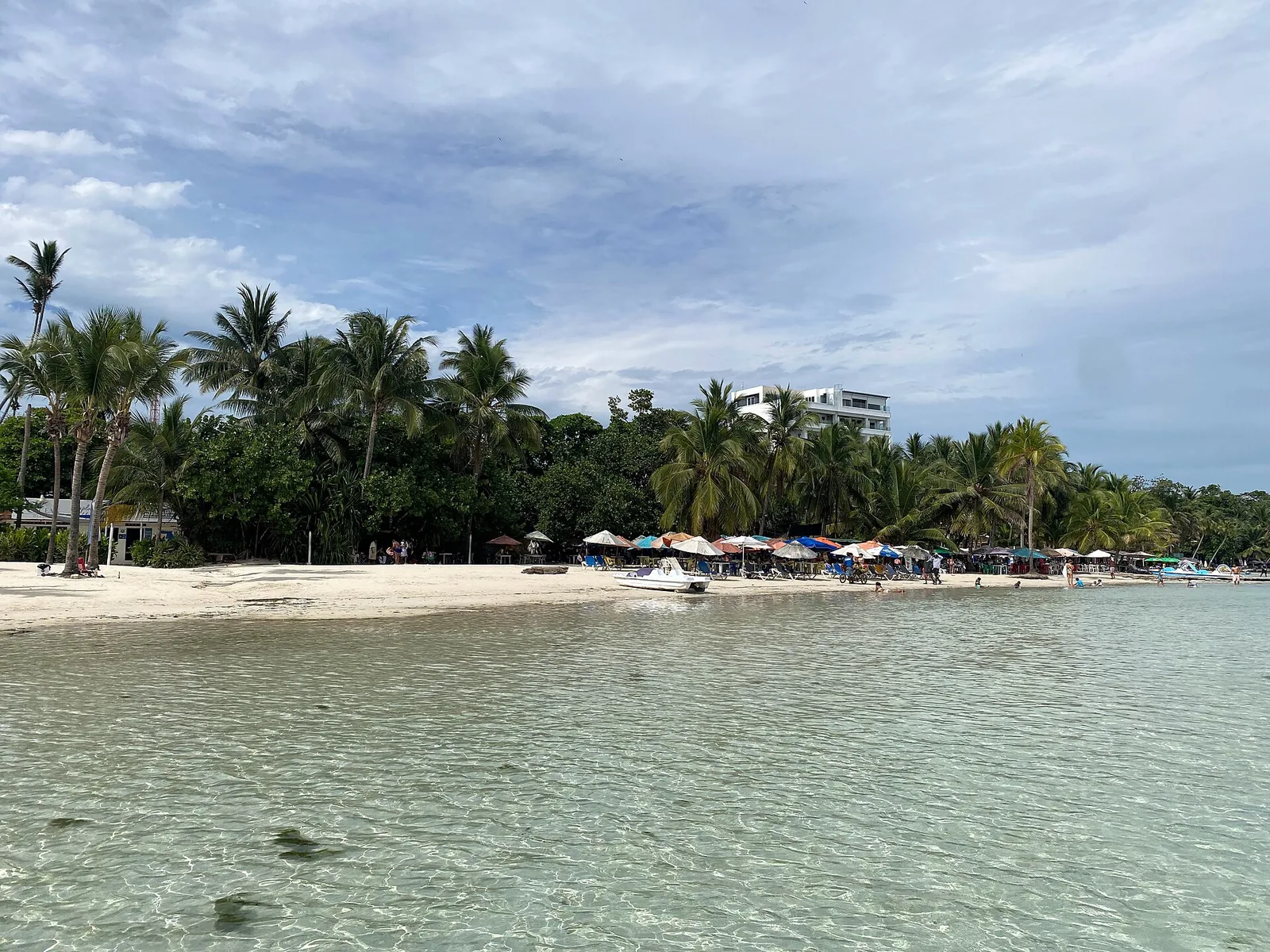
The beach runs for close to a mile of white sand. A large coral reef protects the bay, and the water inside it is no more than four feet deep, which is why Boca Chica is often compared to a giant natural pool. Children can paddle and play close to their parents, and most adults can stand across much of the swimming area.
That shallow, sheltered water makes Boca Chica the easy pick for families with young children, for anyone who wants to lie back in the water with a book waiting on the towel, and for guests who are not strong swimmers.
La Matica
La Matica is a small mangrove cay just off the main beach. It is a roosting and nesting site for birds, herons among them, and you can reach it with a short wade across the shallows. Go in the morning, before the beach fills up, and bring water shoes for the walk across.
Food at Boca Chica
Eating is half the reason to go. Fish fry shacks along the beach serve fresh fish and seafood, and the beachfront restaurants let you eat with your toes in the sand. The classic order is pescado frito, a whole fried fish, with yaniqueques, a crisp fried dough, and an ice-cold beer, the kind Dominicans call "una fría vestida de novia."
At the eastern edge of town there are beach clubs where you can eat a long seafront lunch and swim from a lounge deck over the water. They suit guests who want a table, shade and a restroom close by. For the stands on the sand, carry some cash in pesos; the small vendors on the beach work in cash.
Things to do
Besides swimming, you can rent a paddleboard or a kayak, take a boat ride out to the small islets in the bay, and snorkel near the reef. Short excursions to La Caleta, the underwater park nearby, are also offered from Boca Chica.
The beach hosts sailing races and a beach volleyball tournament every year, so on some weekends you may find a regatta in the bay or a crowd around the courts. On ordinary weekends there is music and a lively local atmosphere on the sand.
When to go
Boca Chica is busiest on weekends, during Easter Week and through the summer, when families from the capital fill the sand. Go on a weekday for space and an easy table at lunch. Visitors who base themselves in Boca Chica usually stay a day or two, but from the Malecón it makes an easy day trip, and you are back in time for dinner in the city.
The beach's address is Avenida Abraham Núñez, which is what to give your driver or type into your app.
A last swim before your flight
Because Boca Chica is close to Las Américas International Airport, it works well for a final swim on the day you fly home. Check out, store your bags in the car, spend the morning in the bay, have an early lunch at one of the fish shacks, and head to the airport from there. Leave yourself time to change and to clear the airport without hurrying.
Diving at La Caleta
Parque Nacional Submarino La Caleta, the La Caleta Underwater National Park, lies off the coast near Boca Chica. It covers about 10 square kilometers of sea, from the Las Golondrinas Cave to Punta Caucedo, with depths from 6 meters (20 feet) down to 180 meters.
The best-known dive is the Hickory, a ship sunk in 1984 by a group of researchers to create an artificial reef. It lies at about 18 meters (60 feet). Deeper down are El Limón and the Capitán Alsina at about 30 meters (100 feet), and the Don Quico at about 58 meters (190 feet).
The seabed drops in three defined terraces, with caves and wrecks along the way. Divers here see grouper, balloonfish, rays, lionfish, octopuses and turtles, along with corals and reef fish. The park suits divers of every level, from beginners to advanced.
Along the coast, the karst rock forms underwater caverns and tunnels, one of them a passage more than 100 meters (328 feet) long, and these are the dives technical divers come for. If you are certified, bring your card and logbook. If you have never dived, ask the dive shop what it offers for first-timers.
La Caleta pairs well with an afternoon on the sand at Boca Chica, since the two are next to each other.
Juan Dolio and Guayacanes
Juan Dolio is the next stretch of coast east of Boca Chica, about 59 km from the Malecón by road and about 40 minutes from Las Américas International Airport. It has beachfront resorts and condominiums, a strip of beachside restaurants, and the relaxed pace of a place people visit for short escapes and weekends away from the capital.
The beaches
Juan Dolio Beach and Hemingway Beach both have calm water that is good for swimming. Guayacanes, about 56 km from the Malecón, is the beach next door with a more local atmosphere. You can paddleboard or kayak where the waves are gentle, and a walk along the coast at sunset rounds off the day.
Food and an afternoon
The beachside restaurants serve local and international dishes, and the strip has enough choice for a long lunch. There are golf courses nearby for guests who want a round before the beach. Daytime temperatures run from 25 to 32 °C (77 to 90 °F), so plan the golf early and the swim for midday.
San Pedro de Macorís and the cave
From Juan Dolio it is a short drive further east to San Pedro de Macorís, a town with a long baseball tradition, and to the Cueva de las Maravillas, a cave with Taíno rock art. Our day trips guide covers both, and the cave pairs well with a swim at Juan Dolio on the way back to the city.
Bayahíbe and Playa Dominicus
Bayahíbe is a village on the southeast coast and the gateway to Saona Island, Catalina Island and Cotubanamá National Park. It is 20 minutes from La Romana and about an hour from Punta Cana. By road it is about 135 km from the Malecón, along the Autopista Las Américas and the Autovía del Este, so it makes a full day out or a night away.
Dominicus and the Blue Flag
Playa Dominicus, just outside the village, holds a Blue Flag for water quality. It raised the country's first Blue Flag in 2004, and by May 2025 the Dominican Republic had 26 certified beaches, among them beaches in Bayahíbe, La Romana and Punta Cana.
The Blue Flag is an international award run by the Foundation for Environmental Education for beaches that meet standards for environmental quality, safety, accessibility and environmental education. Every certified beach is inspected each year to keep its flag, and as of May 2025 there were 5,195 Blue Flag beaches in 51 countries.
Catalina, Cotubanamá and the cenote
From Bayahíbe, boats also run to Catalina Island, a favorite for snorkeling and diving. On land, Cotubanamá National Park has walking trails, caves and cenotes, among them Padre Nuestro, a freshwater cenote inside the park. December to April is the high season on this coast, with drier weather.
Saona Island
Saona Island draws more visitors than all of the country's national parks combined. It lies 19 km south of the mainland, covers 110 square kilometers and is part of Cotubanamá National Park. Long stretches of white sand lined with coconut trees run along its shore, and Mano Juan is the only village on the island.
Day trips go by speedboat or catamaran, and most leave from the small waterfront in Bayahíbe. Boats usually stop at Palmilla, a shallow sandbank in open sea with a wide natural pool, for a swim. Saona is also the country's most important nesting site for sea turtles.
The boat ride is part of the pleasure, with the coastline, its white beaches and its coconut palms going by on the way. A speedboat gets you there faster and leaves more time on the sand; a catamaran makes the crossing itself part of the outing. Either way, wear a hat that will stay on in the wind, and keep sunscreen in your day bag for the trip back.
From Santo Domingo you can book a tour that handles everything. One private speedboat day trip, for example, picks you up at your hotel, drives you to the Bayahíbe dock, stops at El Toro beach, breaks for lunch at Mano Juan, swims at the natural pools and brings you back about 11 hours after pickup. Food, drinks and the national park admission are paid separately on that trip. Expect an early start and a full, happy day.
Najayo and Palenque
Heading west instead of east, the coast of San Cristóbal province has two beaches that Dominican families love for holidays, Playa Najayo and Playa Palenque. Both fill with holiday crowds from the capital at Easter, and on an ordinary weekday they are a calmer way to see the coast west of the city.
Najayo is about 34 km from the Malecón and Palenque about 56 km. Both lie west of the city in the direction of Baní, so they work as a stop on a drive west or as a short beach day on their own.
The beaches around Baní
Further west, the coast around Baní has its own beaches. Playa Los Almendros lies in Boca Canasta, just south of Baní's town center. In July 2026 the Ministry of Tourism started remodeling the beach and the Baní waterfront, with plazas, terraces, picnic tables, children's play areas, outdoor exercise equipment and public restrooms across an area of 9,978 square meters.
Out on the Las Calderas peninsula, the beach at Punta Salinas is well visited, and El Derrumbao, near the Baní dunes, is popular for snorkeling and diving because the reef comes close to the shore. Our Baní and Boca Canasta guide covers the dunes, the salt flats and the mango town in full.
Getting to the beaches
By ride-hailing or taxi
The simplest way to Boca Chica or Juan Dolio is by car. Uber runs in Santo Domingo around the clock, and UberXL takes groups of up to six, which suits a family with beach bags and a cooler. You can also reserve a ride up to 30 days ahead if you want the car waiting at a set time. Before your driver leaves you at the beach, agree on where and when you will meet for the ride home.
By rental car
If you drive, the route east is straightforward: follow the Autopista Las Américas out of the city toward the airport and keep going for Boca Chica and Juan Dolio. The Las Américas toll station has lanes for Paso Rápido, the electronic toll tag, as well as cash lanes. Ask your rental company whether the car has a tag, and keep pesos handy if it does not. Our guide to getting around Santo Domingo covers driving, tolls and parking in more detail.
By tour
For Bayahíbe and Saona, a tour is the easy choice, since the drive is about 135 km each way and boat timings matter. A tour from Santo Domingo handles the hotel pickup, the drive and the boat, and brings you back to the city in the evening.
What to pack for a beach day
Pack light and practical. A bag with towels, sunscreen, a hat and a refillable bottle covers most days. Add a mask and snorkel if you have one, since you can snorkel near the reef at Boca Chica and La Matica is a short wade away. Water shoes help on the walk to the cay. Bring a dry bag for your phone if you are taking a boat.
The Caribbean sun is strong even on a breezy day. Plan your longest swim for the morning, lunch in the shade, and a last swim in the late afternoon when the light softens. For the Baní dunes and the Las Calderas beaches, bring more water than you think you need, light clothes, a hat, sunscreen and repellent.
Beach days with children
For young children, Boca Chica is the clear first choice, because the reef keeps the bay shallow and calm. Set up near one of the beachfront restaurants or a beach club so that shade, lunch and a restroom are all a few steps away. Bring a change of clothes for the ride home, since the drive back to the Malecón takes about half an hour without traffic. If the little ones are still full of energy, La Matica, the mangrove cay a short wade from the beach, is a small adventure with herons to spot.
Beach days for couples
For couples on a city break, Juan Dolio or Hemingway Beach makes a quieter afternoon, followed by a sunset walk along the coast. If you have two days to spare, a night in Bayahíbe gives you Playa Dominicus in the evening and an easy start for the boat to Saona the next morning.
Protected areas
Saona, Catalina and Cotubanamá are part of a national park, and La Caleta is a protected underwater park. Leave shells, coral and sand where you find them, keep your fins off the reef, and give nesting turtles plenty of room on Saona's beaches. Use the boat operators who run trips from the Bayahíbe pier, and follow the crew's instructions in the water.
Beaches through the year
Each season has its own rhythm on the coast. From December to April the southeast is in its high season, with drier weather, and that is the time many visitors choose for Bayahíbe and Saona.
Holy Week is a favorite beach week for Dominican families. In 2027 it falls in the week before Easter Sunday, March 28, with Holy Thursday on March 25 and Good Friday on March 26, and the beaches nearest the capital, Boca Chica, Najayo and Palenque among them, fill from Holy Thursday through Easter Sunday. If you are in town that week, go early in the day or pick a weekday before the long weekend begins.
Summer is the other busy stretch at Boca Chica, when families from the capital spend whole days on the sand. Weekdays stay easier year-round, and a weekday morning at Boca Chica is about as calm as the capital's beach gets.
Choosing a beach for the day
Each beach suits a different kind of day. A quick guide:
- For small children and calm water, go to Boca Chica, where the reef keeps the bay shallow and protected.
- For your first wreck dive, book La Caleta and the Hickory, then lunch at Boca Chica.
- For a calmer beach with room to spread out, go to Juan Dolio, Hemingway Beach or Guayacanes.
- For the island day of the trip, book Saona from Bayahíbe and plan on a long day.
- For a Blue Flag beach and a night away from the city, stay over in Bayahíbe and swim at Playa Dominicus.
- For a Dominican holiday crowd, head west to Najayo or Palenque.
- For dunes, salt flats and snorkeling off the reef, drive to Baní and the Las Calderas peninsula.
A week of beach days from the Malecón
If you are here for a week and want the sea every day, here is one way to plan it. Spend the first evening on the Malecón and at Güibia, getting your bearings. Take a weekday at Boca Chica with lunch on the sand and an afternoon snorkel. Give one morning to La Caleta and the Hickory, or to a paddleboard if you do not dive. Spend a day at Juan Dolio and Guayacanes with a sunset walk. Book Saona on a weekday. Save the last day for the drive west to Baní and the dunes.
Then there is the drive home at the end of a beach day: a shower, an early dinner and the lights along the water.
Book an apartment on the Malecón and keep the sea in view between beach days.