
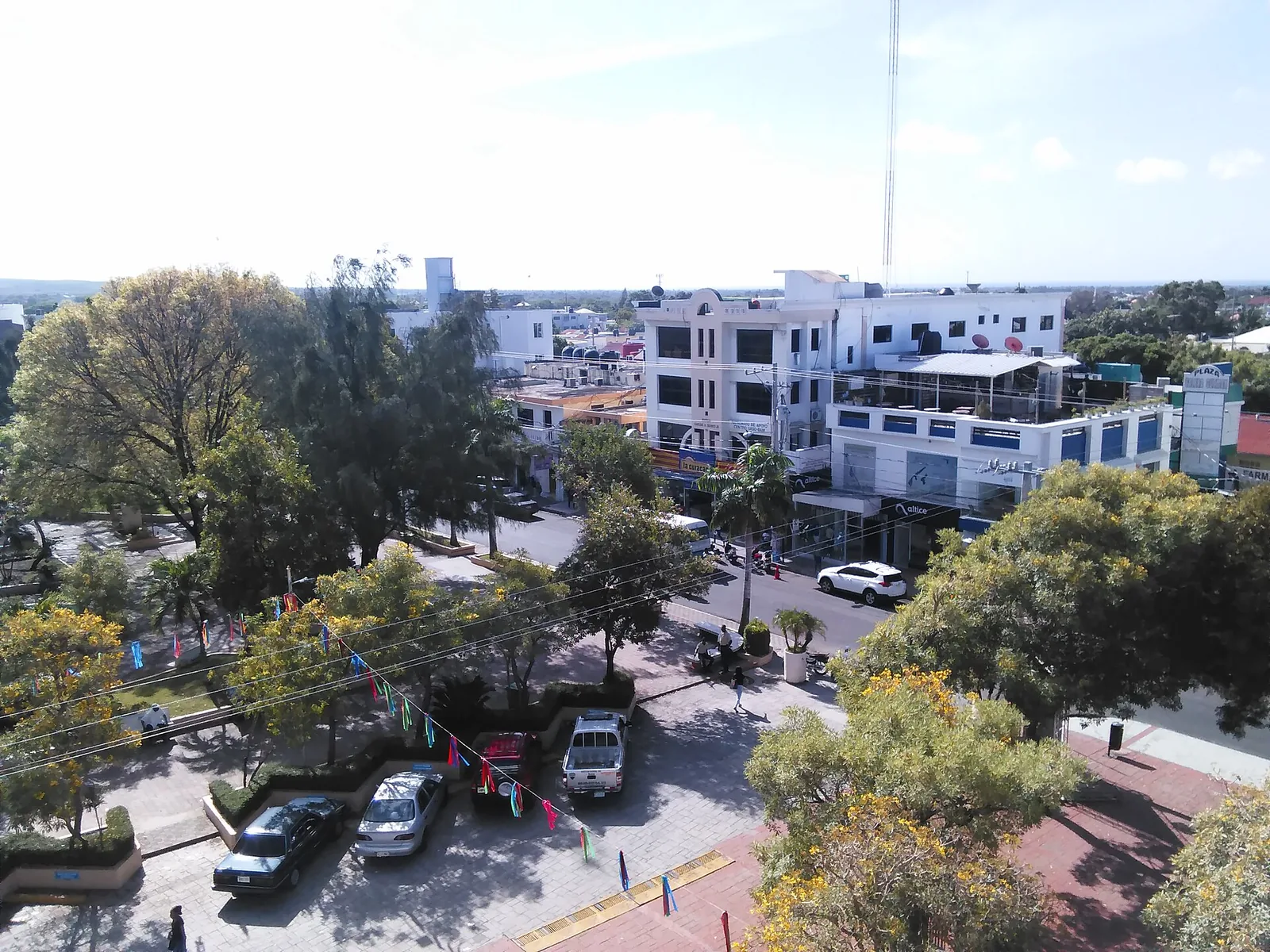

Baní is the capital of Peravia province, on the Caribbean coast west of Santo Domingo. It is a working town known across the country for its mangoes, its sweets and its salt, and for the sand dunes and salt flats on the peninsula to the west. Boca Canasta sits just south of the town center, between Baní and the sea, with its own beach, Playa Los Almendros.
This guide covers the town and its history, Boca Canasta and the beach, the dunes, the salt flats and the bay, the mango and sweets traditions, and the festivals worth timing a visit around.
Getting there from Santo Domingo
By road, Boca Canasta is about 61 km from the Malecón. The route runs west along the coast on the Autopista 30 de Mayo, continues on the Autopista 6 de Noviembre and the Autopista San Cristóbal-Baní, follows the Circunvalación de Baní around the town, and turns down Avenida Fabio Herrera toward the coast.
Once you are in the area, distances are short. Boca Canasta is about 3 km from the center of Baní, about 23 km from the Baní dunes and about 28 km from the village of Las Salinas at the end of the peninsula.
Coming straight from the airport, Las Américas International is east of the capital, so Boca Canasta is about 91 km away by road, through or around the city.
If you are driving from the Malecón, leave after the morning rush, fill the tank before you go, and plan to arrive in time for an early lunch. On the way west you cross San Cristóbal province, home to Najayo and Palenque, two beaches that Dominican families love on holidays. Our beaches guide covers those beaches and the rest of the coast.
A short history of Baní
Baní was founded on March 3, 1764, by the Spanish Captain General Manuel Azlor y Urríes. The name comes from the Taíno language and means abundance of water; it is said to come from a cacique, a Taíno chief, named Baní, who governed the valley before the Spanish arrived. The town marked its 250th anniversary in 2014, with congratulations from the national Senate.
The town has produced a long list of national figures, among them Francisco Gregorio Billini, Camila Landestoy and Héctor Incháustegui Cabral, and five presidents of the republic were born here.
Máximo Gómez
Baní's most famous son is Máximo Gómez y Báez, born in the town on November 18, 1836. He made his name in Cuba: in the Ten Years' War of 1868 to 1878 he rose to general and commander of Oriente Province, and in May 1895 José Martí, Antonio Maceo and Gómez met and named him top commander of the Cuban Liberation Army. He died in Havana on June 17, 1905. In Baní he is remembered as the Generalísimo.
Baní's patron is the Virgen de Regla, Our Lady of Regla, whose devotion goes back to colonial times. Her feast closes the town's fiestas patronales every November.
The capital of the south
Banilejos, as people from Baní are called, have a reputation for hard work, and the Senate has called the town the economic capital of the southern region. Baní is a major producer of sweets, mangoes, coffee and salt, and cattle and goats are raised in the area. In 1995, Peravia was declared a tourism development zone.
Banilejos abroad
Baní's diaspora in the United States keeps the town's traditions alive. In Boston, a group called Banilejos Unidos en el Exterior, founded in 2007, brings together neighborhood associations from across the municipality, among them the Movimiento Desarrollo Bocacanasta, for gatherings they call convites; in July 2015 they held their eighth international convite in Boston. If you have family in Baní, you may already know the Boca Canasta name from one of those convites.
There is a convite in the capital too. Every year Alianza Banileja holds the Convite Banilejo in Santo Domingo; the 19th edition, on November 23, 2025, filled the grounds of the Universidad Nacional Pedro Henríquez Ureña with hundreds of Banilejos and stands showing the town's traditions and food.
The town center
The heart of Baní is its central park, the Parque Marcos A. Cabral, the town's main public space. On January 9, 2026, the town began remodeling it, with an investment of more than RD$37 million. The new design includes a monument to the five presidents of the republic born in Baní and another to the diaspora, the Banilejos abroad who support the town from overseas, and it brings in two founding fathers of the republic, Matías Ramón Mella and Francisco del Rosario Sánchez.
While the work goes on, some events have moved elsewhere in town; in 2026 Expo Mango was held on Avenida Fabio Herrera instead of the park.
Baseball in Baní
Baní has its own ballpark, the Estadio Luis María Herrera. In January 2026 the Ministry of Sports began remodeling it, playing field included, with an investment of almost RD$25 million. The president of the Dominican winter league attended the groundbreaking, and former major leaguers gave a clinic for children and young players from the town's leagues. For the professional game, our baseball guide covers the season at the Estadio Quisqueya in the capital.
Boca Canasta
Boca Canasta is a coastal community of the Baní municipality, about 2.5 km south of the town center, between Baní and the sea. Avenida Fabio Herrera is the road from the Circunvalación de Baní into Boca Canasta, and Playa Los Almendros is Boca Canasta's beach.
Staying in Boca Canasta gives you the quiet of the coast with the shops and restaurants of Baní a few minutes' drive away. It is a good base for a family stay: the beach in the morning, a trip to the dunes or the salt flats, and dinner in town.
Playa Los Almendros and the Baní waterfront
Playa Los Almendros is the beach for Baní and Boca Canasta, and it is getting a new waterfront. On July 30, 2026, the Ministry of Tourism started remodeling the beach and the Baní malecón, a project residents had asked for over many years.
The plan covers 9,978 square meters, with an investment of RD$136,956,834. It includes plazas, terraces, vendor kiosks, landscaping, parking, picnic tables, children's play areas, outdoor exercise equipment, public restrooms and an emergency care point. It is one of the main recreational spaces on the Peravia coast.
While the works are under way, parts of the waterfront may be closed off, so ask locally which stretch of sand is open on the day you go. Once it is finished, the new malecón will give the waterfront plazas and terraces for evening walks by the sea.
The Baní dunes
The Monumento Natural Dunas de Las Calderas, known to everyone as the Baní dunes, is the largest and most important dune system in the Caribbean islands. The protected area covers 20 square kilometers on the Las Calderas peninsula, between the villages of Matanzas, Las Calderas and Las Salinas, about 23 km from Boca Canasta.
How the dunes formed
The sand began forming in the Pleistocene. It is mostly quartz and feldspar, carried to the coast by the arroyo Bahía, the Baní river and the Nizao river, then sorted and piled up by currents, waves and steady winds. The dunes reach 35 meters high and hold an estimated 117.4 million cubic meters of fine sand, and from the top you look over the Caribbean and Las Calderas Bay.
The dunes run about 15 km from east to west, from Matanzas to Punta Salinas. On the way out from Baní, near Sabana Buey, you pass the Matafongo wind farm, whose 17 turbines have supplied power to the national grid since 2019.
The dunes are home to plants and animals adapted to dry, salty conditions. There are no rivers inside the protected area; the vegetation is mostly dry scrub and grassland, adapted to salt, dryness and strong sun, which turns the place into a kind of desert on the Caribbean coast.
Visiting the dunes
The Ministry of Environment manages the dunes, with guides and a surveillance center, and the Santanilla trail runs 1.5 km through the different habitats. Park rangers, the Navy and the environmental protection service patrol the area, including the access roads to El Derrumbao beach and about 16 km of coastline.
The dunes are a popular outing: nearly 13,000 people visited in 2024, 10,580 of them Dominicans and 2,394 visitors from abroad. Vehicles, and off-road vehicles above all, are kept out of the protected area, so plan to park and walk. Bring water, light clothes, a cap or hat, sunscreen and insect repellent, and go early, before the sand heats up.
If you would rather not drive, a four-hour sandboarding tour from Santo Domingo includes hotel pickup in Santo Domingo or Baní, transport by minibus, the boards and an English-speaking guide, with a stop at the salt flats.
Las Salinas and the salt flats
At the western end of the peninsula, past the dunes, lies the village of Las Salinas. Much of the land here is taken up by the Salado del Muerto, a saline lagoon used for salt production by evaporation and ringed by mangroves. Commercial salt is also extracted in the Punta Salinas area.
Salt is part of Baní's identity: the town counts salt among the products it is best known for, along with its sweets, mangoes and coffee. A visit to the salt lagoon shows you where it comes from: seawater left to evaporate until the salt remains.
The beach at Punta Salinas, at the tip of the peninsula, is well visited, and the drive out along the bay is part of the trip. Near the point, fish are raised in sea cages, one of the peninsula's trades.
The landscape here, with its dunes, salt lagoon and blue bay side by side, is popular with photographers and filmmakers, so bring a camera and come back in the late afternoon if you can.
Bahía de las Calderas
Las Calderas Bay is the sheltered bay formed by the peninsula. It is home to a naval base and a shipyard, and to villages including Las Calderas and Las Salinas, where small-scale fishing is one of the local trades.
Birds
The bay is an Important Bird Area, recognized by BirdLife International and the Dominican conservation group Grupo Jaragua. It covers 1,794 hectares, and 124 bird species have been reported there. Bring binoculars if you have them, and visit the mangroves around the salt lagoon early in the day.
Snorkeling and diving
El Derrumbao, a beach on the protected coast of the dunes, is popular for snorkeling and diving because a reef system lies close to the shore. Bring your own mask and fins, and check the conditions before you swim.
Mangoes
Baní is known as the capital of the mango. Peravia has the largest area planted with mango of any Dominican province, more than 1,127 hectares, and the mango banilejo, which grows in Baní and elsewhere in the country, has become a recognized Dominican variety. Most mango trees flower and set fruit from January to February, so a winter visit shows you the orchards in bloom, and the harvest follows toward the early summer.
Expo Mango
Each year the town holds Expo Mango, the Festival de la Cosecha del Mango, in the early summer. The 2026 edition, the 22nd, ran from June 3 to June 7, organized by the Dominican mango cluster, PROMANGO, with the Ministry of Agriculture.
The fair sells fresh mangoes and offers free tastings, cooking contests, music and tours around the province. Growers show off local varieties, among them the Mingolo, considered one of the jewels of the Dominican criollo mango, and the technical sessions for growers took place at the Centro Cultural Perelló.
Baní's mangoes travel. In 2026 the sector set out to export about 10 million boxes, and growers see new markets for criollo varieties in the United States, where Dominican and Caribbean shoppers look for them. Peravia, with the largest mango acreage in the country, is where much of that fruit is grown.
In 2026 the fair moved to grounds on Avenida Fabio Herrera, near the Circunvalación de Baní, because the town's central park was being rebuilt, which put it on the road between Baní and Boca Canasta.
Sweets from Paya
Baní is just as famous for its sweets. Paya, in Baní, is where many varieties of Dominican sweets are made, which is why it hosted the Festival del Dulce de Baní in May 2023, organized by the government's agricultural development fund, with farm products, crafts, workshops and talks alongside the sweets.
Look for dulce de leche, milk fudge in its many forms, coconut sweets, sweets made from cajuil, the cashew fruit, and fruit preserves, along with the mountain sweets called dulces cimarrones, such as bombón and bienmesabe. A box of dulces from Baní makes a good gift to bring home.
For more on what to eat in the Dominican Republic, from breakfast to the sweets that end a meal, see our Dominican food guide.
Fiestas patronales
Each November, Baní celebrates its patron, Nuestra Señora de Regla. In 2025 the fiestas patronales ran from November 11 to November 21 in the Plaza Joaquín Sergio Incháustegui, with local and national artists on stage and games in the neighborhoods. The opening night ended with a concert by the singer Sergio Vargas.
The festival also opens the Christmas season in Baní: on November 11, 2025, the town lit its Christmas tree in the plaza and gave Christmas its official welcome.
Baní with children
The dunes make a good outing with children: the climb to the top, the run down and, on a tour, a turn on a sandboard. Keep the visit to the morning, bring plenty of water, and plan a swim afterward. The new waterfront at Playa Los Almendros will add children's play areas, picnic tables and restrooms close to Boca Canasta, and a stop in Paya for sweets is an easy reward on the drive back.
Getting around the area
A car makes the area easy to explore, since the beach, the town, the dunes and the salt flats are spread along the coast. From Boca Canasta, Baní's center is about 3 km away, the dunes about 23 km and Las Salinas about 28 km, and the drive out along Las Calderas Bay is a pleasure in itself. If you are visiting for a day from the Malecón, a tour with hotel pickup takes care of the driving.
Planning your days around Baní
A few days in Boca Canasta give you time for everything the area offers. Here is one way to spend them:
- First morning: settle in, walk down to Playa Los Almendros and have lunch in Baní, about 3 km away.
- Second day: drive out early to the dunes, about 23 km away, climb to the top for the view of the bay, and continue to Las Salinas for the salt flats and the beach at Punta Salinas.
- Third day: snorkel at El Derrumbao, or spend the day at the beach in Boca Canasta.
- Any afternoon: stop in Paya for sweets, and in June, spend an evening at Expo Mango.
- One day: drive back east for the capital, about 61 km, to see the Colonial Zone and the Malecón.
Baní through the year
A few dates to plan around:
- January and February: the mango trees flower and set fruit
- March 3: the anniversary of the town's founding in 1764
- Early June: Expo Mango, the mango harvest festival, June 3 to 7 in 2026
- November 11 to 21: the fiestas patronales for Nuestra Señora de Regla, opening with the Christmas tree lighting in 2025
- Late November: the Convite Banilejo in Santo Domingo, held on November 23 in 2025
A day trip from the Malecón
If you are staying in the capital, Baní makes a full day out. Leave the Malecón after breakfast and drive about 61 km west to Baní. Head out to the dunes while the morning is still cool, climb to the top for the view over the bay, and continue to Las Salinas for the salt lagoon and the beach at Punta Salinas. On the way back, stop at Playa Los Almendros for a late swim and in Paya for a box of sweets, and you will be back on the Malecón for the sunset.
When to go
The drier months, from November to April, are a comfortable time for the dunes and the salt flats. June brings Expo Mango, and November the fiestas patronales and the Christmas lights. Wherever you go on the peninsula, carry plenty of water and sun protection.
What to bring
Carry some cash in pesos for sweets in Paya and small purchases along the coast, and fill the tank in Baní before heading out to the peninsula. Pack for sun and sand: hats, sunscreen, light long sleeves for the dunes, sandals and closed shoes, a reusable water bottle and a cooler for the car. Add a mask and snorkel for El Derrumbao and binoculars for the birds of the bay.
Questions guests ask
How far is Boca Canasta from Santo Domingo?
About 61 km by road from the Malecón, west along the Autopista 6 de Noviembre and the Autopista San Cristóbal-Baní, and about 91 km from Las Américas International Airport.
Can we visit the dunes on our own?
Yes. The Monumento Natural Dunas de Las Calderas is managed by the Ministry of Environment, with guides and a surveillance center on site, and nearly 13,000 people visited in 2024. Leave the car where the rangers indicate, since vehicles are kept off the dunes.
When is mango season?
The trees flower and set fruit from January to February, and the harvest is celebrated at Expo Mango in early June, held June 3 to 7 in 2026.
Where do we buy sweets?
Paya, in Baní, is where many varieties of Dominican sweets are made; look for dulce de leche, coconut sweets and cajuil sweets.
Our day trips guide covers more trips from the capital, from the caves of Los Tres Ojos to Saona Island.
For a family stay in Boca Canasta, our pool villa sleeps 16.